Looking at the small-sport-bike class in the U.S. motorcycle market, two things are very clear. First, that today’s younger buyers, the ones most often drawn to this category, have options that are vastly superior to what was available just 10 or 15 years ago. And second, Kawasaki has absolutely dominated the class with its Ninja 500 and its predecessors.
Honda has apparently grown tired of watching consumers walk past its CBR500R with barely a glance as they purchased a Ninja 500, so the company made one big change for the 2026 model year: not an update to the engine, brakes, or suspension, not a re-style of the fairing, but rather a new price. Specifically, Honda cut the MSRP for the CBR500R by $1,000. And that has changed the conversation.
Now that you can buy a CBR500R for $100 less than a Ninja 500 SE ABS, the highest of Kawasaki’s three trims in the model line and the one that’s most closely equipped to the Honda, I decided it was time to take a closer look at how the two compare.
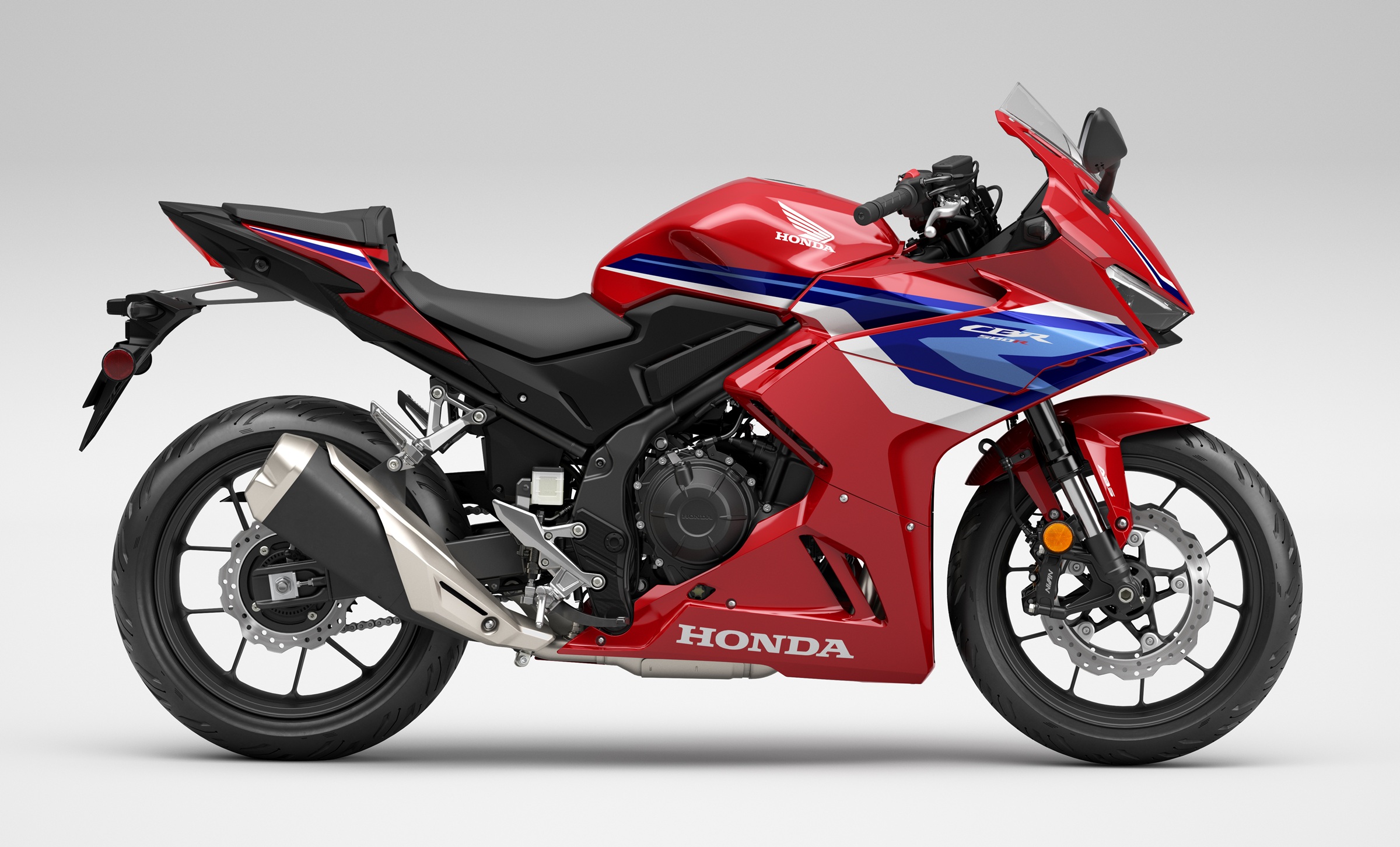
If you like the Honda, you’d better like the traditional red with white and blue accents. The CBR500R has a clear family resemblance to the company’s flagship sport bike, the CBR1000RR-R, though the liter bike is roughly four times as powerful. Honda photo.
Honda CBR500R and Kawasaki Ninja 500: What’s the same, what’s different
Honda offers one version of the CBR500R and it’s more fully equipped than any of its competition, which is mainly the Ninja 500 but also includes the Aprilia RS 457. But since there are about 10 times as many Honda and Kawasaki dealers in the United States as there are Aprilia dealers, most customers are shopping either red or green in this category.
Compared to Honda’s one trim, Kawasaki offers three trim levels. Here’s the breakdown:
- Kawasaki Ninja 500 SE ABS: $6,499
- Honda CBR500R: $6,399
- Kawasaki Ninja 500 ABS: $5,799
- Kawasaki Ninja: $5,399
All three trims in the Ninja line are the same mechanically. A buyer simply has to decide whether to order with or without ABS. (I think anyone riding on the street should have the safety net of ABS and the extra $400 will more than pay for itself if just one time you don’t spot that slick manhole cover in the dark on a rainy night when you have to brake unexpectedly.) The SE model adds a full-color TFT digital display instead of the simpler LCD display on the other Ninjas, adds Kawasaki’s KIPASS keyless ignition system, and a few other bits such as a USB-C outlet, a larger windscreen, a cover for the pillion seat, and frame sliders.
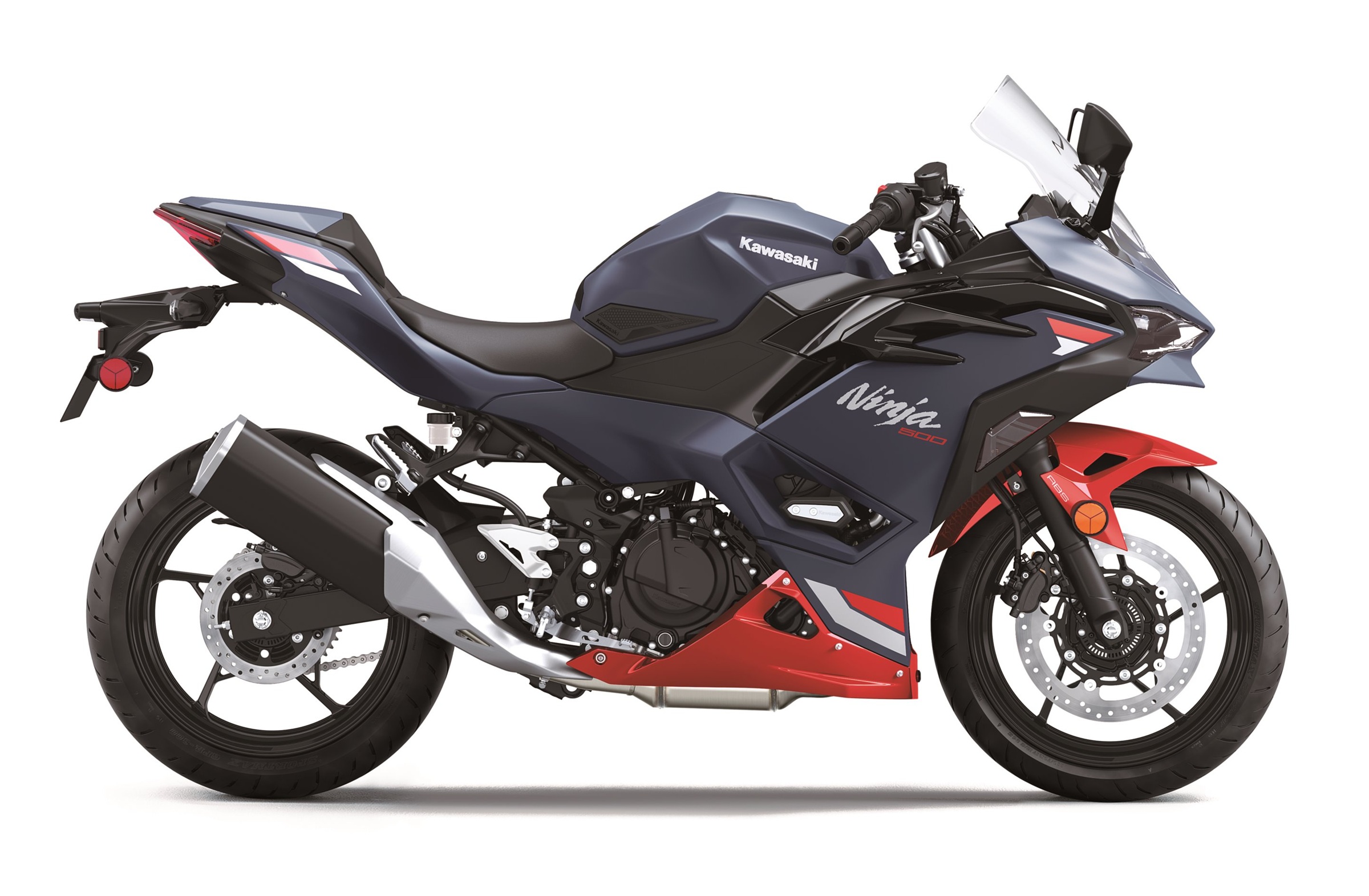
While the Honda comes in just one trim, the higher volume of the Ninja 500 line means Kawasaki offers four different color options, including the traditional lime green, naturally, and also this colorfully named Metallic Matte Twilight Blue/Candy Persimmon Red color scheme. Kawasaki photo.
The CBR500R always was the better equipped option in the category. It has a five-inch TFT display, like the top-of-the-line Ninja 500 SE ABS. The Honda comes with ABS standard and it also offers a few features the Kawasaki lacks. The Honda has dual front disc brakes instead of a single disc and has a more sophisticated Showa SFF-BP (Separate Function Fork-Big Piston) inverted fork (though the only suspension adjustment on both the Honda and Kawasaki is rear preload; the Aprilia RS 457 also offers front preload adjustability). In its redesign in 2024, Honda also added its Honda Selectable Torque Control (HSTC) basic traction control to the CBR500R. Unlike higher-spec models, there’s no ability to adjust levels of intervention but it can be turned off. The only features the Kawasaki offers that the Honda does not have is the keyless ignition and bits such as the USB-C outlet.
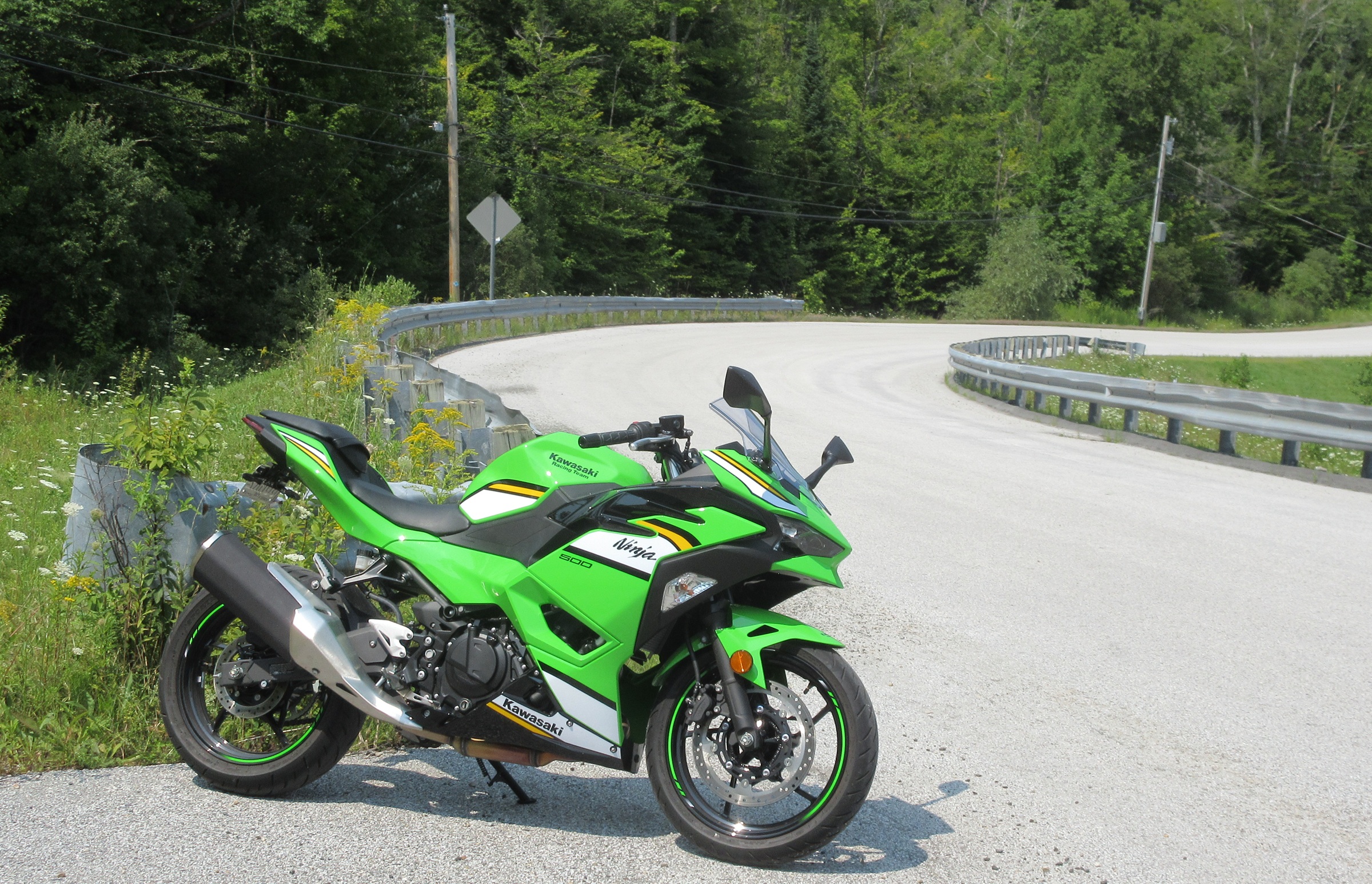
The Ninja 500 easily outsells its competition in the lightweight sport bike class in the U.S. market.
When the Honda cost $1,000 more, its additional features weren’t enough to draw buyers away from the Kawasaki. But now that the price is virtually the same, the conversation has changed.
On paper, the two bikes look quite similar. Both are 500s only if you round up. Both are powered by liquid-cooled, four-valve-per-cylinder parallel twins, 451 cc for the Kawasaki and 471 cc for the Honda. Both mimic the appearance of their bigger and far more expensive siblings that serve as the basis for Superbike racing, so riding one of these you don’t feel like you have a sign on your back screaming “I’m a noob who bought a beginner bike!”
To really feel the different personalities these two motorcycles have, you need to ride them. Fortunately for me, once I’d borrowed a CBR500R from Honda, a comparison was simple. Comoto, parent company of the Common Tread blog I edit as my day job, recently bought a 2025 Ninja 500 for the fleet the company uses for photo shoots, test-fitting accessories, or for showroom displays so customers can try on gear and test it in the riding position before buying. I temporarily rescued the Ninja from its boring life as a model to get it out on the road and ride it back to back with the CBR500R.
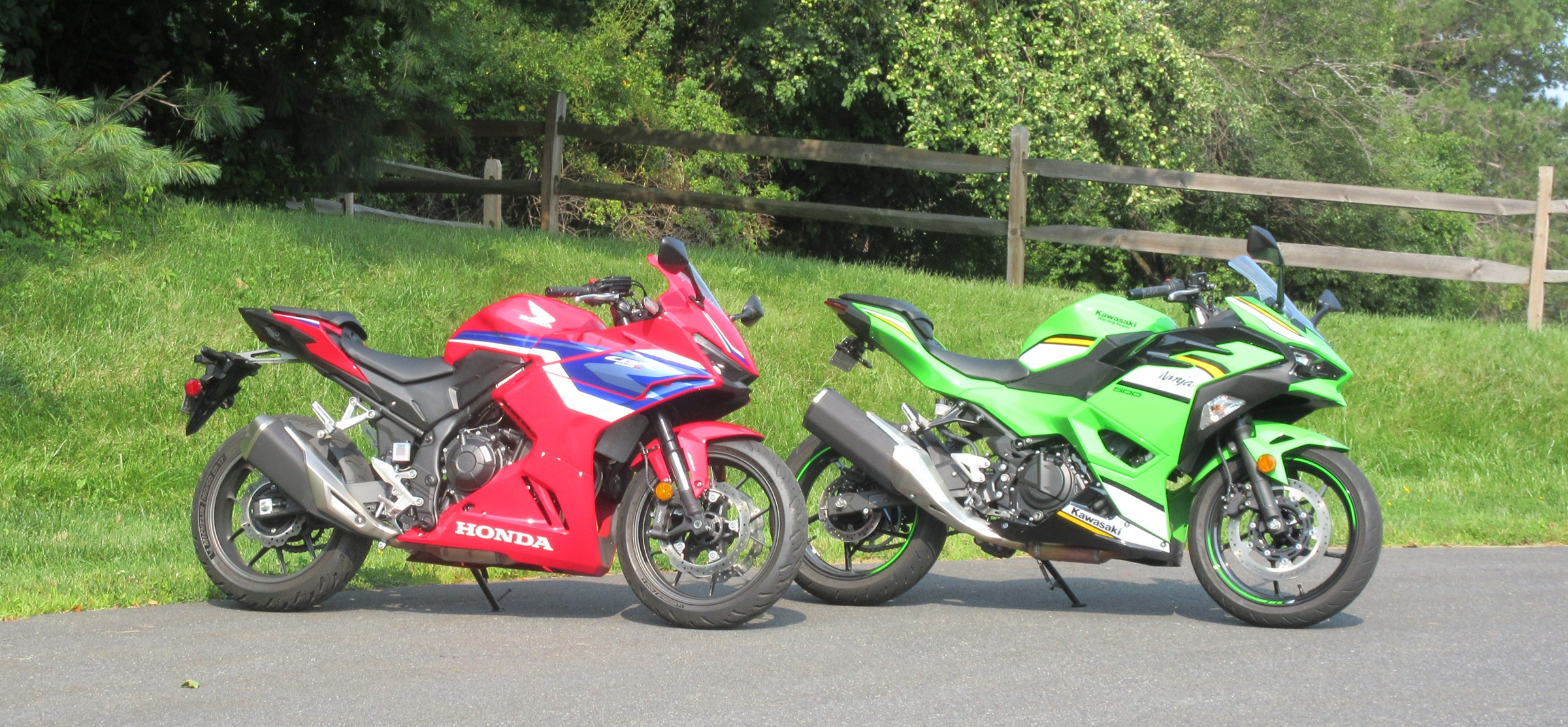
The 2025 Ninja 500 I borrowed from the fleet for the purposes of this comparison is not an exact apples-to-apples comparison with the better equipped CBR500R, but all Ninja 500s have the same engine, suspension, and brakes, so the 2025 was useful for comparing the essential personalities of these two machines by riding them back to back.
Those comparison rides really revealed the different personalities of two motorcycles that, on the surface, can look nearly identical. For reference purposes, below are a few key specs that hint at the characteristics that create those different personalities.
| Honda CBR500R | Kawasaki Ninja 500 | |
| MSRP | $6,399 | Base: $5,399 ABS: $5,799 SE ABS: $6,499 |
| Engine | 471 cc liquid-cooled parallel twin | 451 cc liquid-cooled parallel twin |
| Redline | 8,500 rpm | 11,000 rpm |
| Front brake | Dual 296 mm discs, four-piston calipers, ABS | Single 310 mm disc, two-piston caliper, ABS optional |
| Rear brake | 240 mm disc with ABS | 220 mm disc, ABS optional |
| Front suspension | 41 mm Showa SFF-BP inverted fork 4.7 inches of travel | 41 mm conventional fork 4.7 inches of travel |
| Rear suspension | Showa single shock adjustable for preload 4.7 inches of travel | Single shock adjustable for preload 5.1 inches of travel |
| Seat height | 31.1 inches | 30.9 inches |
| Claimed wet weight | 421 pounds | 370.4 to 377.1 pounds, depending on trim |
| Wheelbase | 55.5 inches | 54.1 inches |
| Rake/trail | 25.5 degrees/4.0 inches | 24.5 degrees/3.6 inches |
| Tires | 120/70-17 front, 160/60-17 rear | 110/70-17 front, 150/60-17 rear |
| Fuel capacity | 4.5 gallons | 3.7 gallons |
For me, engine character and weight are the two most dominant factors that affect how a motorcycle feels, and those two details are the main differences — though not the only differences — between the CBR and the Ninja.
You only have to look at the redlines of the two engines to realize that much more than 20 cc of displacement separates them. Naturally, neither twin produces that high-end rush of their four-cylinder, 600-class siblings, the CBR600RR and the Ninja ZX-6R (which cost roughly twice as much, in addition to making twice the horsepower), much less their liter-class counterparts. But revving to the Ninja 500’s 11,000 rpm redline definitely feels more sport-bike-like than revving to the CBR500R’s 8,500 rpm redline.
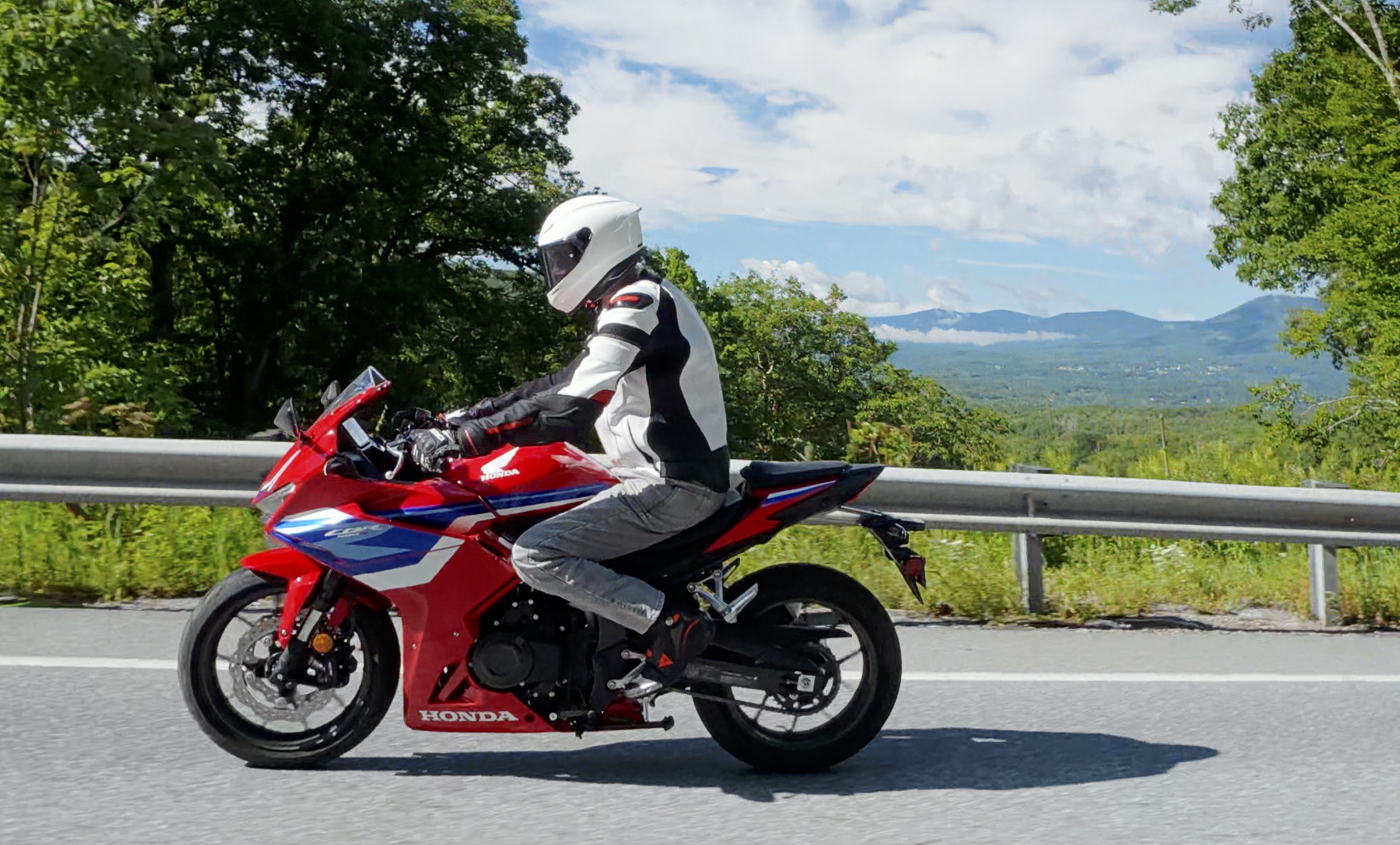
During the two weeks I rode these two motorcycles in a broad mix of riding, the Honda averaged 64 miles per gallon and the Kawasaki averaged 62 mpg. The CBR500R’s 4.5-gallon tank makes it easy to go 250 miles between fueling stops, giving it a range that beats many dedicated sport-touring motorcycles. Photo by Lindsay Comer.
On the highway, an indicated 70 mph in sixth gear puts the Ninja at 6,500 rpm and the CBR at 5,700 rpm. The Honda engine exudes calm competence, not frenetic performance. It’s among the smoother twins I’ve ridden. There’s not much reason to flirt with redline, but there’s also no penalty for keeping the engine in its mid-range. Meanwhile, the Kawasaki encourages you to ride a little harder, though with horsepower in the high 40s on tap, you’re still not going to be drag racing Hayabusas.
The Ninja’s lower weight contributes to its performance advantage at least as much as the engine’s character. Rolling the CBR500R out of the garage, it feels light enough. Then I roll out the Ninja 500 and it feels lighter. Out on the road, the difference in handling is slight, but detectable. It takes just a bit more effort on the clip-ons to initiate a turn on the Honda, though by any measure both of these bikes qualify as nimble.
Glancing back at the specs above, you’ll also notice a few other factors that contribute to the Kawasaki’s slightly lighter handling: a wheelbase 1.4 inches shorter, one degree less rake on the fork, and tires that are one size narrower front and rear.
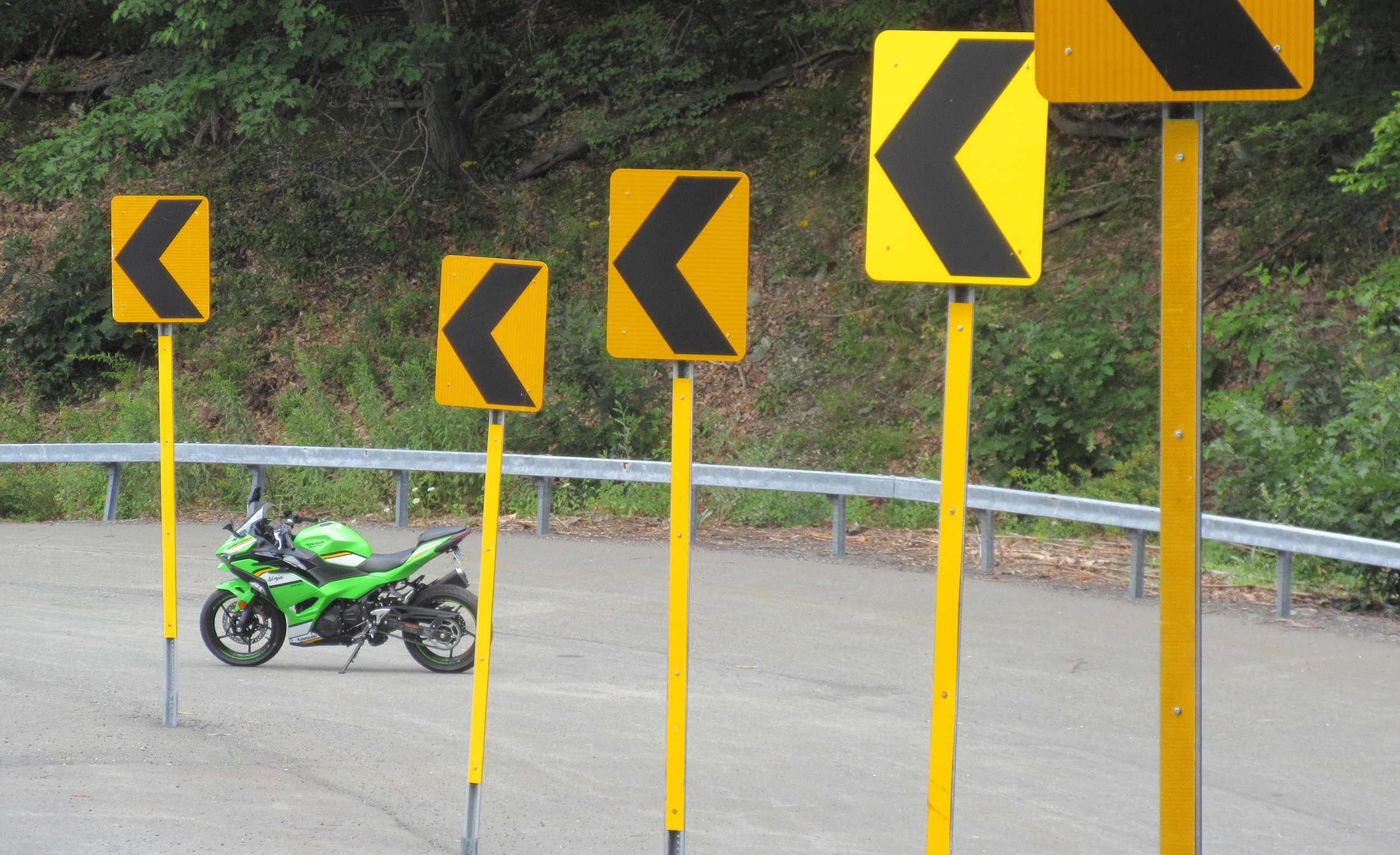
When the curve warning signs proliferate like this, either of these 500-class sport bikes is a good choice, thanks to their nimble handling.
The suspension carries on the same theme. The fork on the Ninja feels sport-bike-firm, which is great when the pavement is smooth or maybe you’re at a track day. On crumbling city streets, however, that firmness can be jarring after a while. By comparison, the Honda’s more sophisticated Showa SFF-BP inverted fork, while also plenty firm for sharp handling when the road is smooth and twisty, does a better job of soaking up those sharp-edged bumps. I suppose if I took both bikes to the track and rode them harder, I might find a handling advantage in the Ninja, but for street riding, I never felt I was paying any handling penalty for the Honda’s better suppleness.
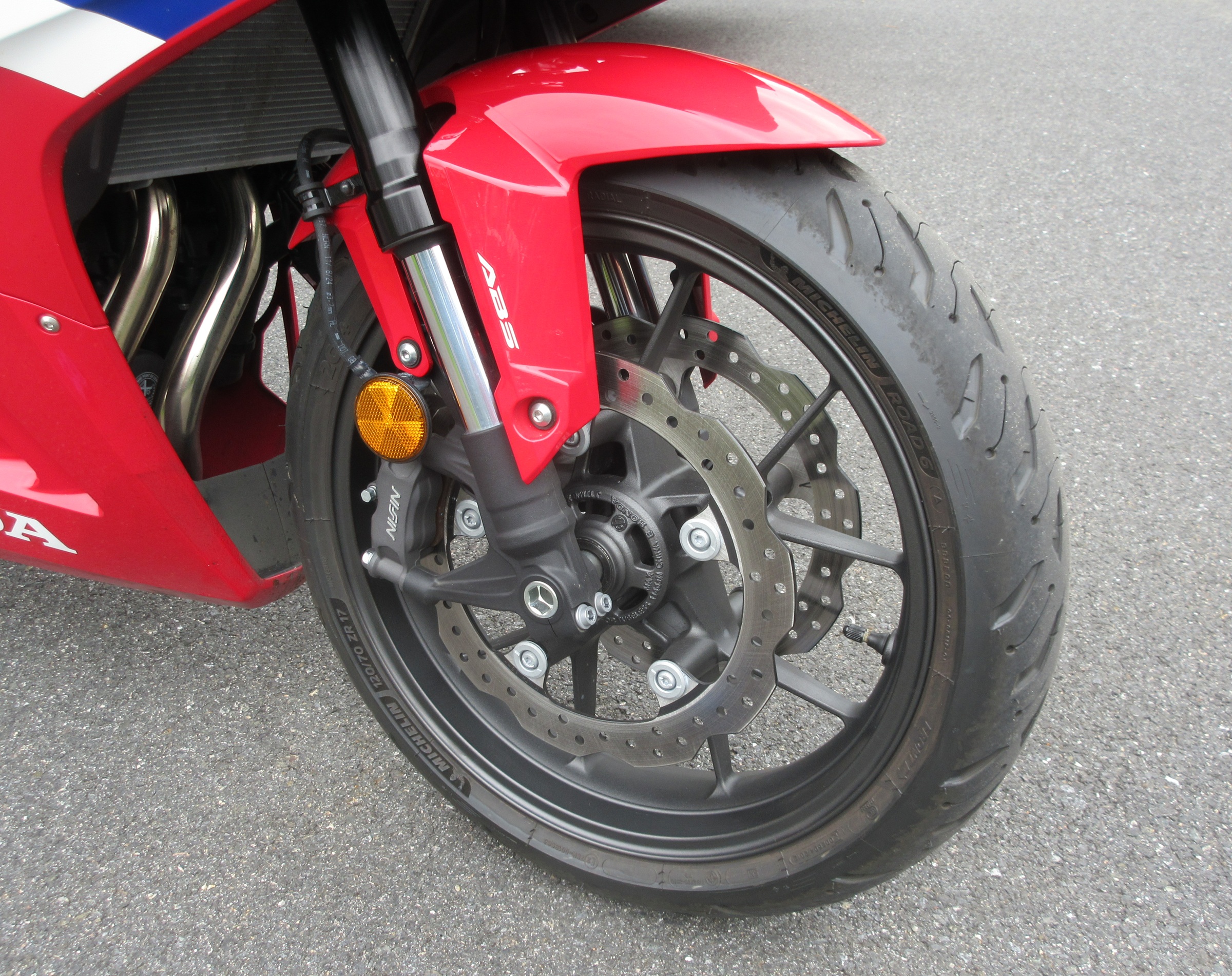
The Showa SFF-BP front suspension and dual disc brakes, instead of a single disc, are among the features the Honda CBR500R offers that the competition doesn’t match.
Surprisingly, the single-disc front brake on the Ninja feels just as strong as the dual-disc setup on the CBR. I prefer the feel of the Honda’s brakes, however, and I wonder if a different set of pads might add a sharper bite. The Honda’s brake lever is adjustable; the Kawasaki’s isn’t. Either way, I had no complaints about the brakes on either motorcycle and since many newer riders will be buying these machines, the lack of an abrupt bite in the Honda’s brakes is probably appropriate.
Both bikes have slipper-and-assist clutches. Pull is light on the Honda. Pull is exceptionally light on the Kawasaki. Shift action is more precise on the Honda’s transmission. I occasionally had some trouble finding neutral on the Kawasaki.
The Honda’s seat is flat and firm, as you’d expect on a sport bike, but not uncomfortable by class standards. The Kawasaki’s seat is smaller and even firmer.
Is the pattern becoming clear? Plot the CBR500R and the Ninja 500 on the broad spectrum of motorcycles and those dots will be close together. But not the same. In just about every detail that differentiates them, the Kawasaki leans a bit more sporty, the Honda more refined. In fact, riding the CBR500R I was struck by how much it reminded me of a scaled-down version of the 2014 Honda VFR800 Interceptor I previously owned. That VFR was considered by many the embodiment of a sport-touring motorcycle, and the CBR500R often felt to me more like a smaller, lighter sport-touring bike than a lightweight sport bike: solid, smooth, competent, not toy-like.
And while that may not be the image Honda’s aiming at with its paint and fairing that resemble the CBR1000RR-R Fireblade SP Superbike platform, that’s not a bad thing. Many young riders buy one of these as their first new motorcycle and use it as their one and only ride for a bit of everything. The CBR500R is a step slower if you’re pushing these bikes as far as socially acceptable on the street, but if I were setting off for a trip on a long weekend ride, I’d choose the Honda.
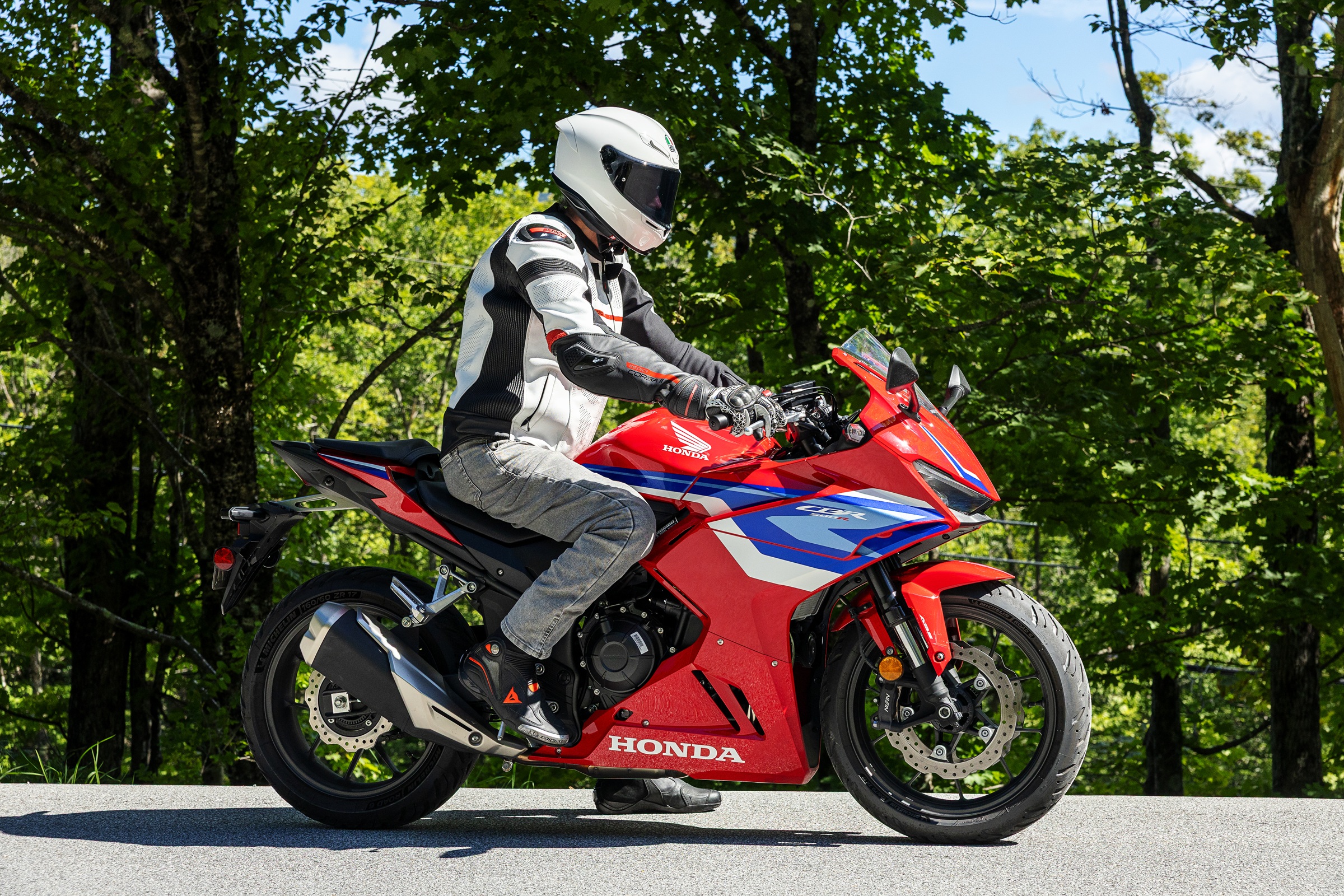
The ergonomics on both the Honda and the Kawasaki are similar and are closer to sport-touring comfortable than the more aggressive riding position of the high-strung race replicas, like the Honda CBR600RR or Kawasaki Ninja ZX-6R. Photo by Lindsay Comer.
So should you buy a CBR500R or a Ninja 500?
A variety of riders might be considering these bikes, so the answer is not the same for everyone. Here’s how I’d break it down, from the least common to most common use case.
A few experienced riders buy one of these as a third or fourth bike to use as an inexpensive track-day ride, one that will force them to improve their technique because you can’t cover your mistakes with an application of 200 horsepower. In that case, the choice is clear: Get the base Ninja and spend the savings on track-day fees and tires. But that’s a tiny sliver of the buyers.
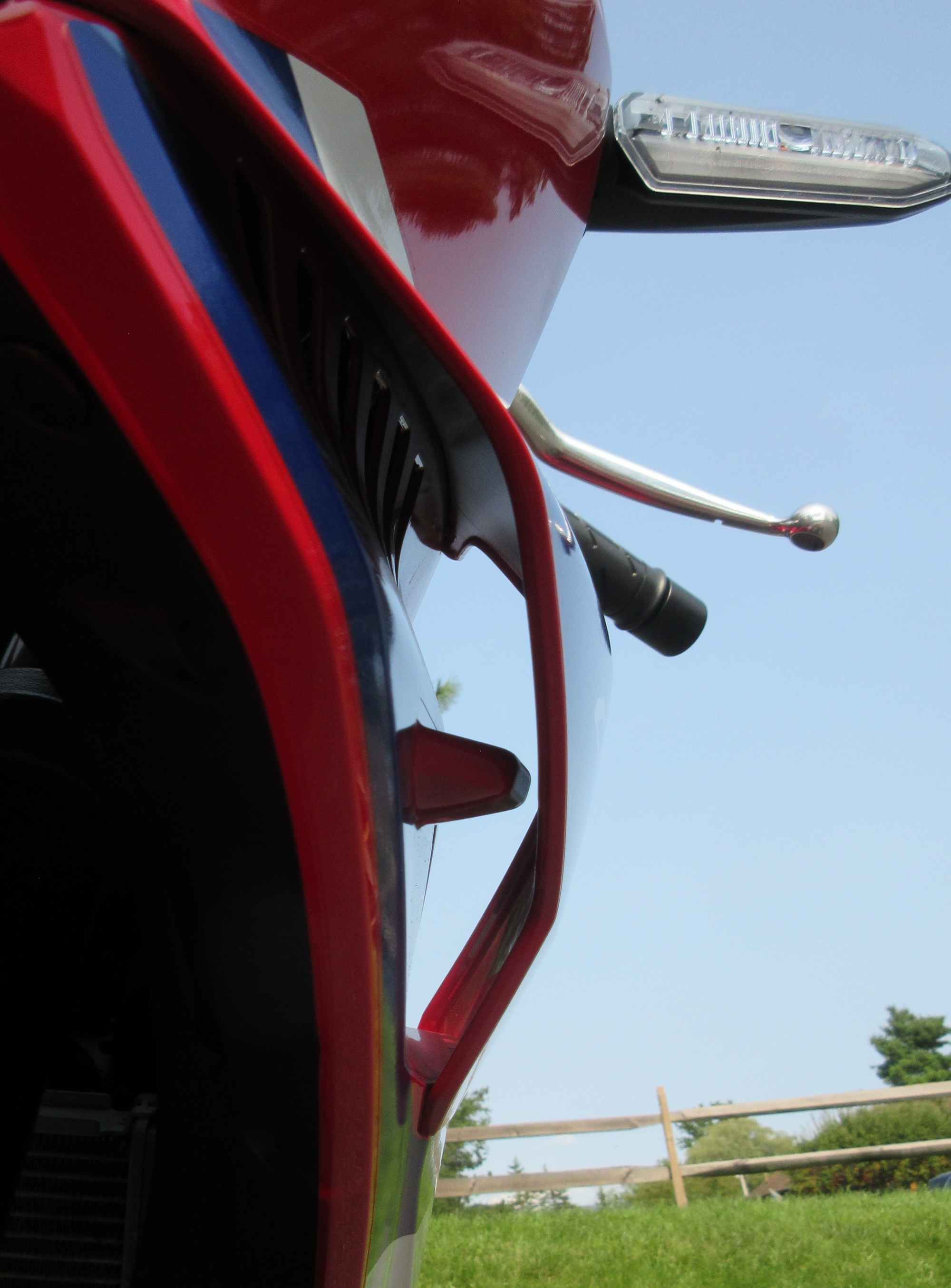
It’s 2026 so sport bikes have to have wings. Fortunately, these 500s don’t have the big, droopy mustaches. The CBR500R’s winglets, for example, are tucked discretely inside the fairing tunnel. Does that two square inches of surface area really make any difference on a motorcycle making less than 50 horsepower? I suspect the real purpose of the winglet is to exert downforce on a buyer’s reluctance to purchase a small motorcycle in the showroom.
Another small segment of buyers of these motorcycles I’ve seen are experienced riders who have a couple of heavier, more complex bikes in the garage and want something simpler, more nimble, and more comfortable for all-around use, not track days. In some cases, older riders are downsizing to machines like these. In that case, I’d lean toward the Honda for its traction control and smoother running, though it may depend on what else is already in the garage. The Kawasaki might fit in better if the rest of the lineup lacks a sporty streak. In either case, I’d encourage this experienced rider not to be one of those who says “I’ve been riding 30 years and I don’t need no stinkin’ ABS!” Get the ABS. It’s not that you need it every time you apply the brakes because you don’t know what you’re doing. It’s for when things don’t go as expected.
Most of the potential buyers, however, are not track-day addicts or experienced riders but are younger and newer riders. Motorcycle Industry Council (MIC) surveys show young people still prefer sport bikes in larger numbers than other demographic slices, and the purchase price, cost of insurance, and power levels of these two put them within reach. I see the ideal Ninja 500 or CBR500R buyers as riders who started with a used motorcycle and are stepping up to their first new motorcycle.
If you’re that younger rider and you absolutely must buy new and you’re stretching your budget to the limit, then there’s a good argument to be made for the Ninja 500 ABS at $700 less than the SE and $600 less than the Honda. None of the features on the SE feels like something I couldn’t live without. The TFT display is fancy, but the LCD display is functionally just as good and the engine, suspension, and brakes are the same as the SE’s.
If you’re that younger rider and you’re leaning toward the Ninja 500 SE ABS, however, then the CBR500R should also definitely be on your list. While you give up a little speed with the Honda, it’s not a big difference, and in exchange you get a motorcycle that will feel more solid and comfortable on road trips and has a more supple suspension that will be more comfortable day in and day out. Plus, you get the added insurance of basic traction control. I took the CBR500R out to a dirt road near me and whacked the throttle to see what would happen. The traction control let the rear tire slip a bit and the CBR’s tail wagged to let me know things were happening back there, and then the wheels got back in line like nothing happened. The on-off HSTC traction control on the CBR500R is a basic system, but there’s no real downside that I can see.
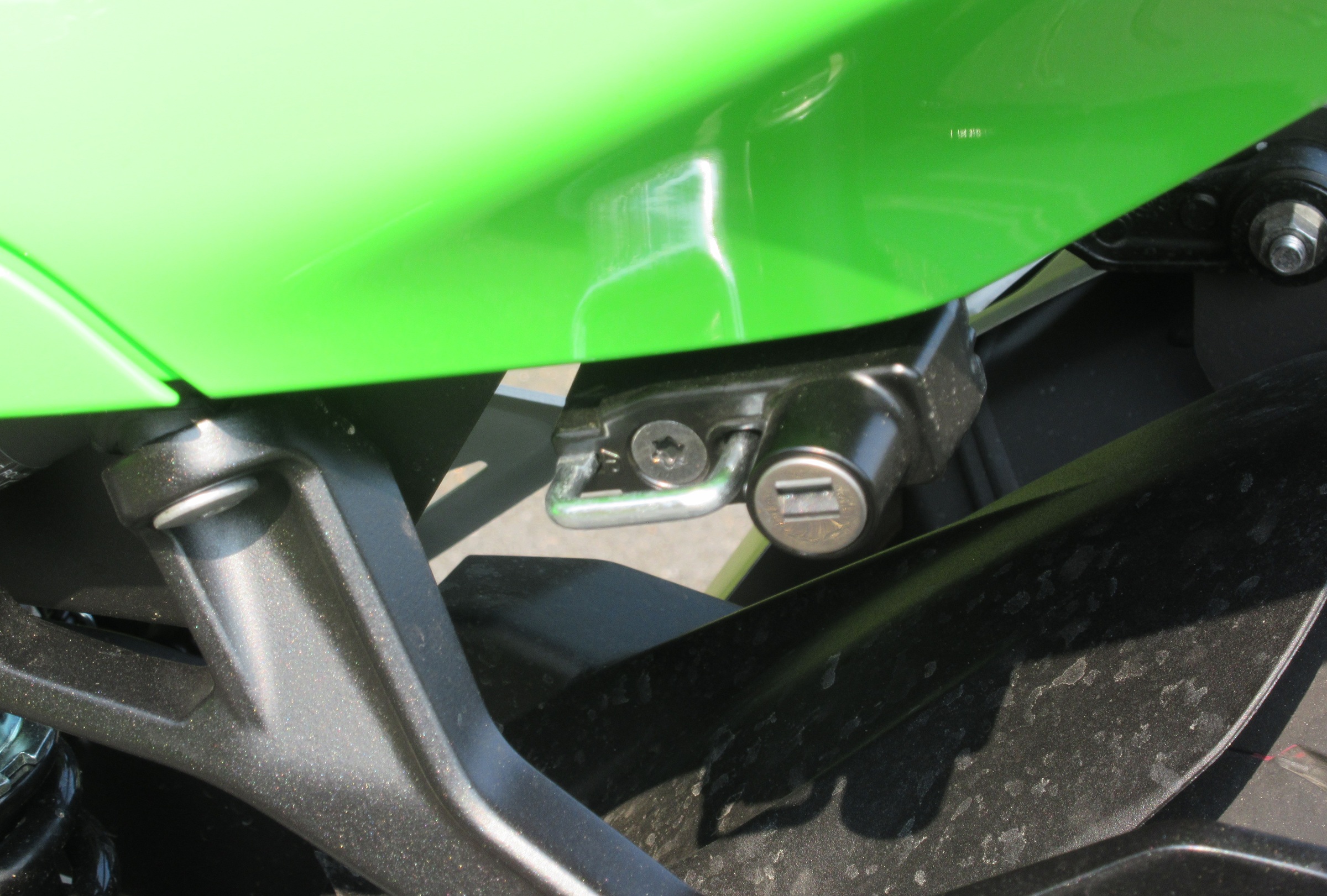
Let’s talk little stuff. I remember when most motorcycles had integrated, keyed helmet locks. Now they’re rare, though they’re useful every time I park in public. Fortunately, Kawasaki still provides them on some models. The Ninja also has bungs for swingarm spools, always handy for a motorcycle with no center stand. The Honda doesn’t have them. Most mystifying, however, is why Honda decided a few years ago to switch the position of the turn signal and horn switches on the left switchgear, instead of leaving them where they’d been for decades. That means I now often startle a pedestrian with an unexpected horn toot when I really just want to signal a left turn.
Can the CBR500R now dethrone the Ninja 500?
While a $1,000 price cut definitely changes the conversation and puts the Honda CBR500R squarely up against the Kawasaki Ninja 500 SE ABS, I don’t have any illusions that Honda is suddenly going to take the lead in this category. Kawasaki is just too far ahead, by so many measures. Ever since the days when the humble Ninja 250 was about the only full-fairing sport-styled motorcycle under 600 cc that you could buy in the United States, Kawasaki’s smallest sport bike has often been its best-selling model in this country. That continued as it grew to a Ninja 300, then 400, and now it continues with the 500.
With three trim levels of the Ninja 500 available, its enduring popularity, and the strong aftermarket support that has grown up around the Kawasaki, I’m sure the CBR500R won’t overcome the Ninja’s lead in this category all at once. Maybe not ever. I suspect many riders will still feel they “need” the added sportiness of the Kawasaki over the smoother competence of the Honda, even if they may tap that added capability only occasionally. If I were choosing one of these two machines to be my one-and-only do-it-all motorcycle, I’d go for the Honda, even though sometimes the Kawasaki is more fun. And the more I was inclined to take longer rides or weekend trips, the more I’d lean red.
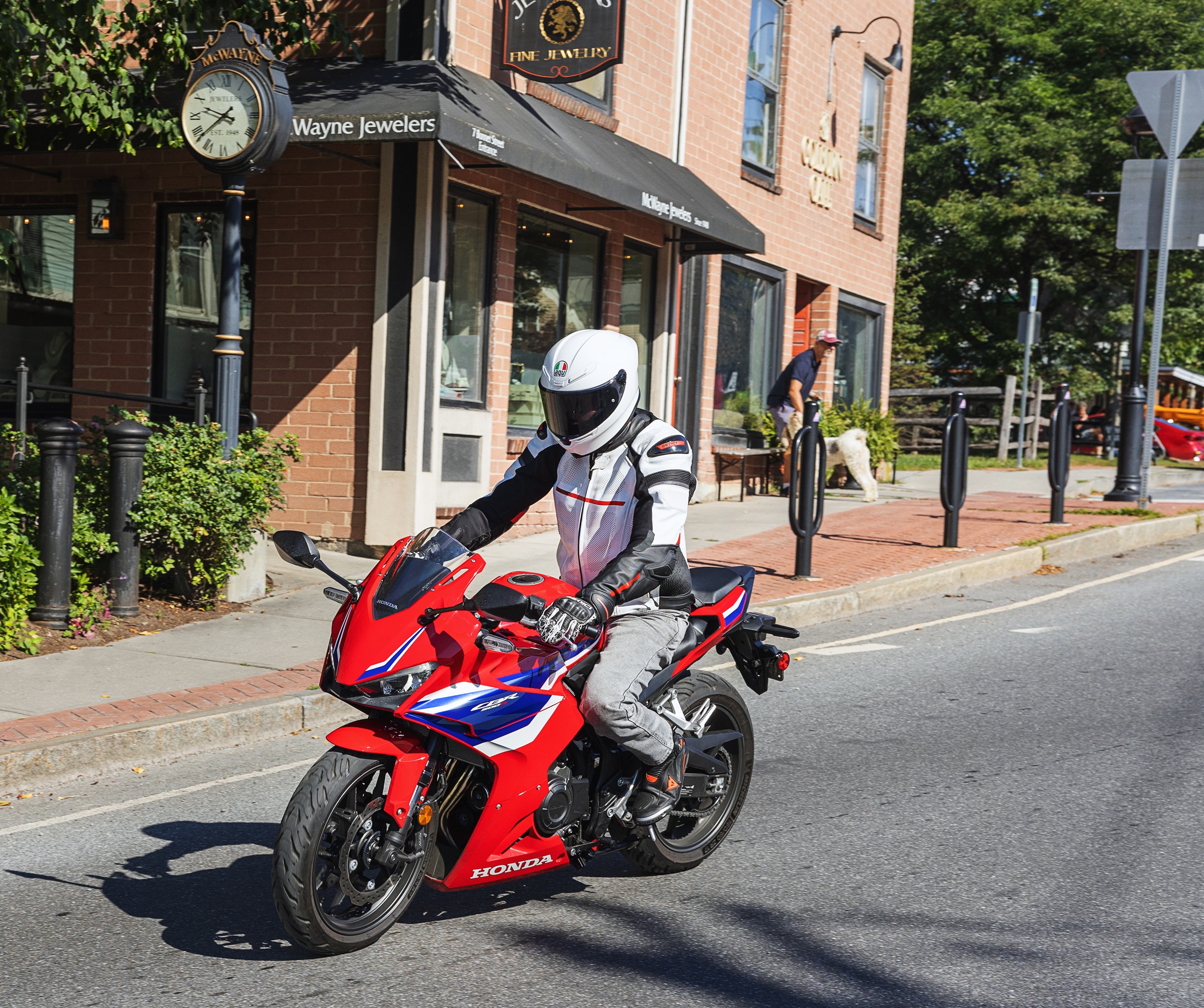
Both of these motorcycles make a good choice for a young rider looking for one bike to do a little of everything. They’re nimble for easily handling around town and for fun rides on the weekends, and they’re comfortable and capable enough to take off for a multi-day trip. Photo by Lindsay Comer.
The really good news, however, is how vastly superior these two motorcycles are to the choices earlier generations of riders had when shopping for something sporty but manageable and affordable. Two of the first four motorcycles I owned were Japanese-built parallel twins in this displacement category, and I would have thought I’d died and gone to some impossible heaven if I’d ridden either of these bikes back then, instead of those wheezy, air-cooled twins of old. Never mind how much better these motorcycles look.
So which do you choose, Ninja or CB? Choose which category above you fall into and make your pick accordingly. That’s my advice. And rest assured that whichever way you go, these are the best of times to be shopping the half-liter sport-bike category.