Maybe you’re coming from sport or sport-touring motorcycles and your knees and back aren’t as young as they used to be. Maybe you’re six feet, four inches tall and just don’t fit comfortably on most motorcycles. Maybe, as you walk into your local Starbucks, you want to project a dusty image of an intrepid traveler who could, just maybe, set off for Kazakhstan at any moment.
OK, the latter of those three is a tired and overused internet trope at this stage, but you probably get my point. There are multiple reasons riders are shifting to adventure-touring motorcycles, and the middleweight class is particularly interesting and popular these days. BMW essentially invented the adventure-touring class with the 1980 R80G/S, but it took decades before the category caught on more broadly. Then it went the usual route, with the motorcycles getting bigger, more powerful, more complicated, and more expensive, with bikes like the BMW R 1300 GS, Honda Africa Twin, Triumph Tiger 1200 Rally Pro, and the Harley-Davidson Pan America all topping 500 pounds. That led to the next inevitable stage in human fads, where new products that are less expensive and complex are created to fill the gap left behind by the bloated and less accessible flagships.
So that’s essentially why the middleweight adventure-touring category is currently so popular. They’re comfortable enough for long rides without feeling like riding a numb sofa. They’re practical enough for getting to work or bringing home some groceries without looking bland or boring (that whole “I wonder if he’s off to Kazakhstan?” thing). They offer plenty of performance to be fun without being overkill and bristling with levels of power, weight, and features that make them hard to afford or hard to handle, on the road or especially off pavement.
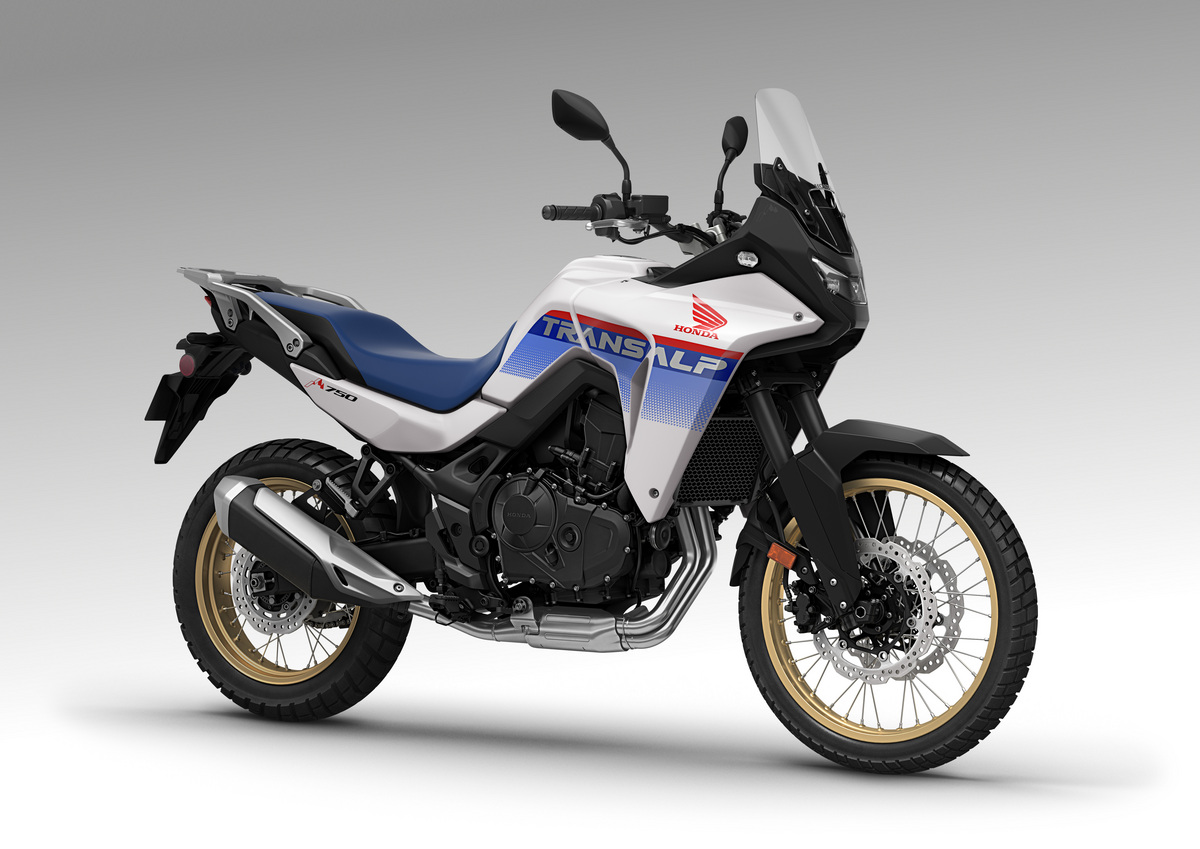
When the Transalp first come to the U.S. market as a 2024 model, it was available only in matte black while Europe got other colors, including this white with red and blue accents that recalled the look of the original Transalp in 1989. Fortunately, for the 2025 model year, Honda is bringing both the white version above and the Deep Pearl Gray color of the unit I tested, seen in the other photos. Honda photo.
I’ve had summer flings with two middleweights that exemplify the class, and comparing the two reveals both why the class is popular and what features to consider when deciding which one best suits your riding profile. I previously rode the Aprilia Tuareg 660 for 1,040 miles and I just finished 1,732 miles on a Honda XL750 Transalp. Both are excellent motorcycles that show why middleweight adventure-touring bikes are so popular and so versatile, but they also have individual strengths and weaknesses. Let’s see how they stack up.
Tuareg and Transalp: The basics
The Aprilia Tuareg 660 carries an MSRP of $12,499 in the United States. Even at a glance, the rally-style wind protection and the 21-inch front and 18-inch rear wheels, wearing Pirelli Scorpion Rally STR tires on the unit I tested, clearly cut an adventure-touring profile. The five-inch TFT dash lets you choose from three preset ride modes, Urban, Explore, and Off-Road, plus an Individual mode you can customize with your choice of traction control, throttle response, and engine braking levels. Off-Road mode disables rear wheel ABS and you can also disable it at the front, if you want.
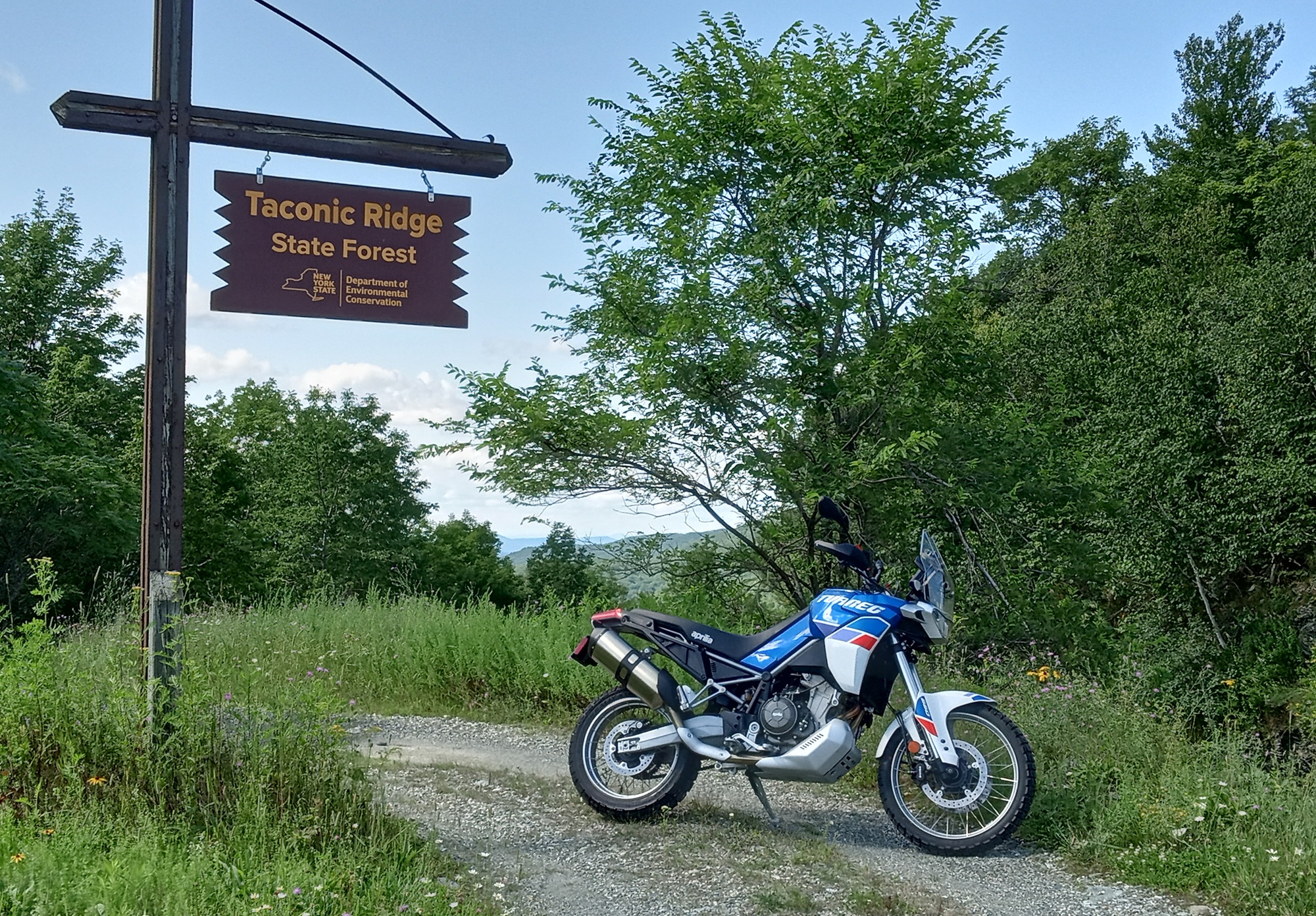
Earlier model years of the Tuareg 660 were available in this color scheme called Indaco Tagelmust, which referred to the indigo coloring the North Africa Tuareg people used as adornment.
The Honda XL750 Transalp has an attractive MSRP of $9,999 in the United States. It also sports an 18/21-inch wheel set, wearing Metzeler Karoo Street tires on the unit I tested. It also has a five-inch TFT display, an upgrade for the 2025 model year, and offers Standard, Sport, and Gravel ride modes, plus two User modes you can customize. You can completely shut off traction control and rear ABS (but not front ABS) in the User modes, along with selecting your level of engine braking and throttle response, but when you turn the key off the traction control and ABS will reset to the default position of on. So you have to adjust your User mode every time you start the Transalp, if you want those safety nets off.
Tuareg and Transalp engines
Parallel-twin engines are often the subject of dismissive or even derisive comments these days. It was the same more than 40 years ago when I first started riding and all the budget bikes I could afford were powered by parallel twins. Today’s backlash has a lot to do with how the parallel twin configuration has taken over so many classes of motorcycles, squeezing out the diversity of V-twins, inline fours, V-fours, triples, and others we’ve been showered with in recent decades.
However, the parallel twins in both these adventure bikes are nothing to complain about. The Tuareg uses the 659 cc engine also found in the Tuono naked bike and the RS660 sport bike, just retuned for adventure duty. It’s an excellent engine in all those applications, providing good throttle response and a broad spread of power without roughness or undue vibration.
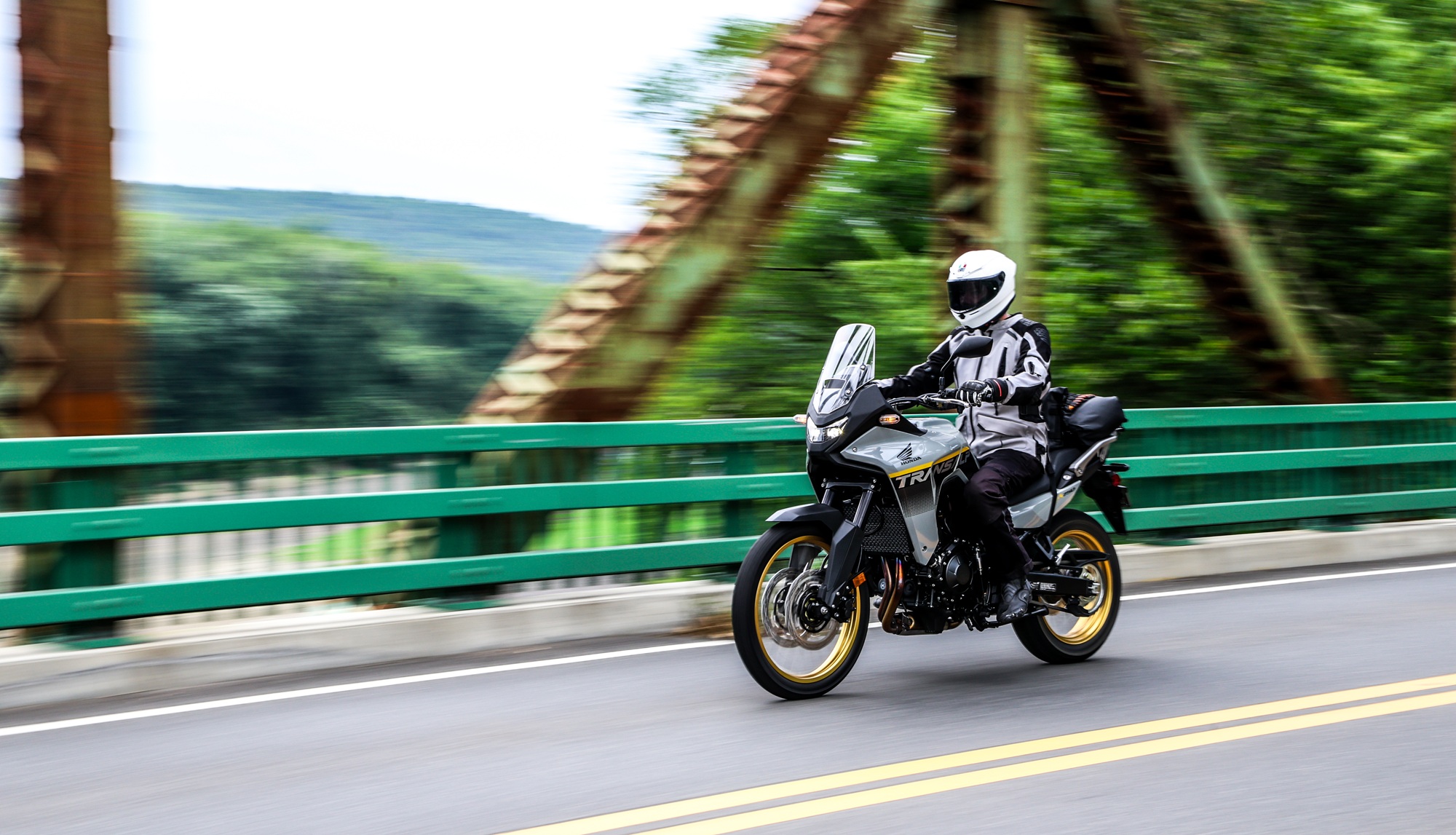
The Honda Transalp makes for a comfortable long-distance touring mount, by the standards of adventure-touring motorcycles. Photo by Todd Verlander.
Similarly, the 755 cc twin in the Transalp provides decent low-end grunt and a satisfying rush to the 10,000 rpm redline. The engine was developed for the CB750 Hornet naked sport bike, so it comes with some standard performance features you might not expect on an adventure-touring bike, such as a slipper/assist clutch and a bidirectional quickshifter. When I went to the Hornet press intro, the engine pulled off quite a feat among the jaded motorcycle writers on the ride. On one hand, with few exceptions they felt it had that “character” many riders are looking for, but on a long ride that doesn’t manifest as roughness or vibration or glitchy fueling or any of the other attributes that may be forgivable as “character” on a short ride but are tiring and annoying on a long trip.
The Tuareg and Transalp respectively claim around 80 and 90 horsepower at the crank, not the rear wheel. I understand why many riders find that to be the sweet spot. Instead of buying a 160-horsepower motorcycle that needs a full array of electronic rider aids to prevent the pilot from killing himself by spinning the rear tire or wheelying over backwards, there’s a lot to be said for a quantity of power that’s never strained in any reasonable street-riding scenario but is also manageable in a way that makes it fun, rather than life-threatening, for the average mortal.
Suspension and handling
Keep in mind that I’m primarily a street rider. I rode lots of miles on both these motorcycles on everything from four-lane interstate highways to dirt roads through local forests and farms, but I did not do any actual off-road riding on trails or truly rough terrain. In the setting in which I rode them, which is how the vast majority of buyers will ride them, I expect, both of these middleweights handled great. But a comparison also shows some significant differences.
One of the things the higher price on the Tuareg gets you is fully adjustable suspension at both ends, specifically Kayaba units with 9.45 inches of travel. By comparison, the Showa suspension on the Transalp provides 7.9 inches of travel at the front and 7.5 inches at the rear and is adjustable only for preload. This is one of several small differences that position the Tuareg more toward the off-pavement end of the spectrum while the Transalp is inclined more toward paved roads.
In reality, both of these motorcycles handle far better on the road than I expected. I especially pushed the Tuareg beyond its intended performance envelope by taking it to a track day training session specifically for non-sport bikes. The limiting factors on the track were my skills (with modern motorcycles, the rider is almost always the limiting factor) and the STR tires, and the tires were far better than I expected. Similarly, on my multi-state trip on the Transalp I detoured to ride one of my favorite curvy road sections in West Virginia and was impressed with how the bike and the tires inspired confidence even in tight turns. Inputs to the wide handlebar yielded the expected response without any surprises, such as the bike wanting to tip in or run wide. Could a sport bike or a sport naked motorcycle hustle through a little faster? Yes. But at any sane speed on public roads, neither the Tuareg nor the Transalp had me feeling like I was missing out. You sacrifice very little in the way of on-pavement performance for the gains you get in handling the road when the asphalt ends.
The one unanswered question I have about the Transalp is how it would handle a heavier rider (I weigh 175 pounds before riding gear) or two-up riding. Considering that I was using up a more-than-recommended amount of the rear suspension travel just with static sag, I have doubts about how the Transalp’s handling would stand up if it were more heavily loaded. I didn’t take a passenger on either of these motorcycles, so I can’t say for sure.
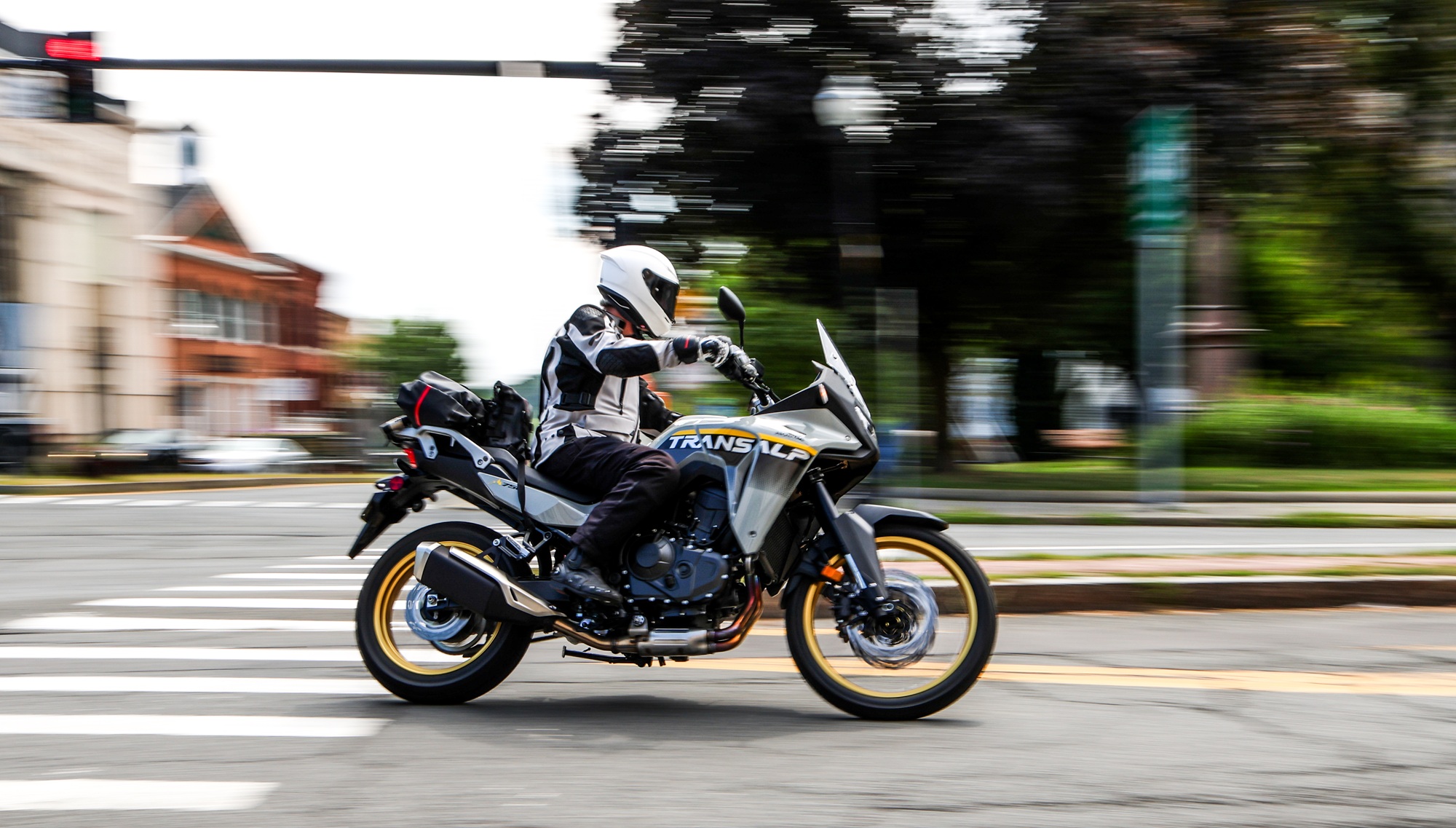
Both the Transalp (above) and the Tuareg make good city bikes, with stable but fairly light handling and responsive, low-end power. Photo by Todd Verlander.
Features and comfort
There are a few differences in the features these two motorcycles provide, some you’d expect and others you probably wouldn’t.
As mentioned above, the higher-priced Tuareg comes with adjustable suspension. It also comes standard with cruise control and spoked wheels that allow the use of tubeless tires, two features the Transalp does not match. Meanwhile, the quickshifter is standard on the Transalp but an extra-cost option on the Tuareg.
Just as the Tuareg’s suspension is more off-road-oriented, so is its seat. It’s narrower than the Honda’s seat and will become uncomfortable sooner on long street rides. The Tuareg’s wind management is also not quite as good as the Transalp’s, with more buffeting. For reference, I’m five feet, 11 inches tall with a 32-inch inseam. I could slouch down behind the Tuareg’s clear windscreen and put myself in a bubble of calm air, but that negates the comfortable, upright riding position that is one of the main reasons many people buy an adventure-touring motorcycle. Another comfort issue with the Tuareg is engine heat. The shape of the fairing sends hot air onto the rider’s shins. It’s most noticeable on a hot day when you’ve been sitting at a stop light, the engine getting seriously warm below you, and as soon as you start moving the air flow through the fairing aims that heat right onto your leg.
In addition to a more comfortable seat (by adventure-touring standards; the Transalp is unlikely to be confused with its Gold Wing sibling), the Honda also has better wind management. The windscreen and fairing were mildly redesigned for 2025 and I experienced almost no buffeting. The airflow over the screen hit me high on the forehead.
While both motorcycles list a seat height that’s just a fraction of an inch different, the Tuareg felt taller to me, despite the Aprilia’s seat being narrower, which should make it easier to get my feet on the ground. I believe the difference was due to the soft rear spring on the Honda’s shock, along with the preload being set too low. In hindsight, I probably should have increased the preload to reduce the amount of static sag, which would have effectively made the seat a bit taller when I was sitting on it.
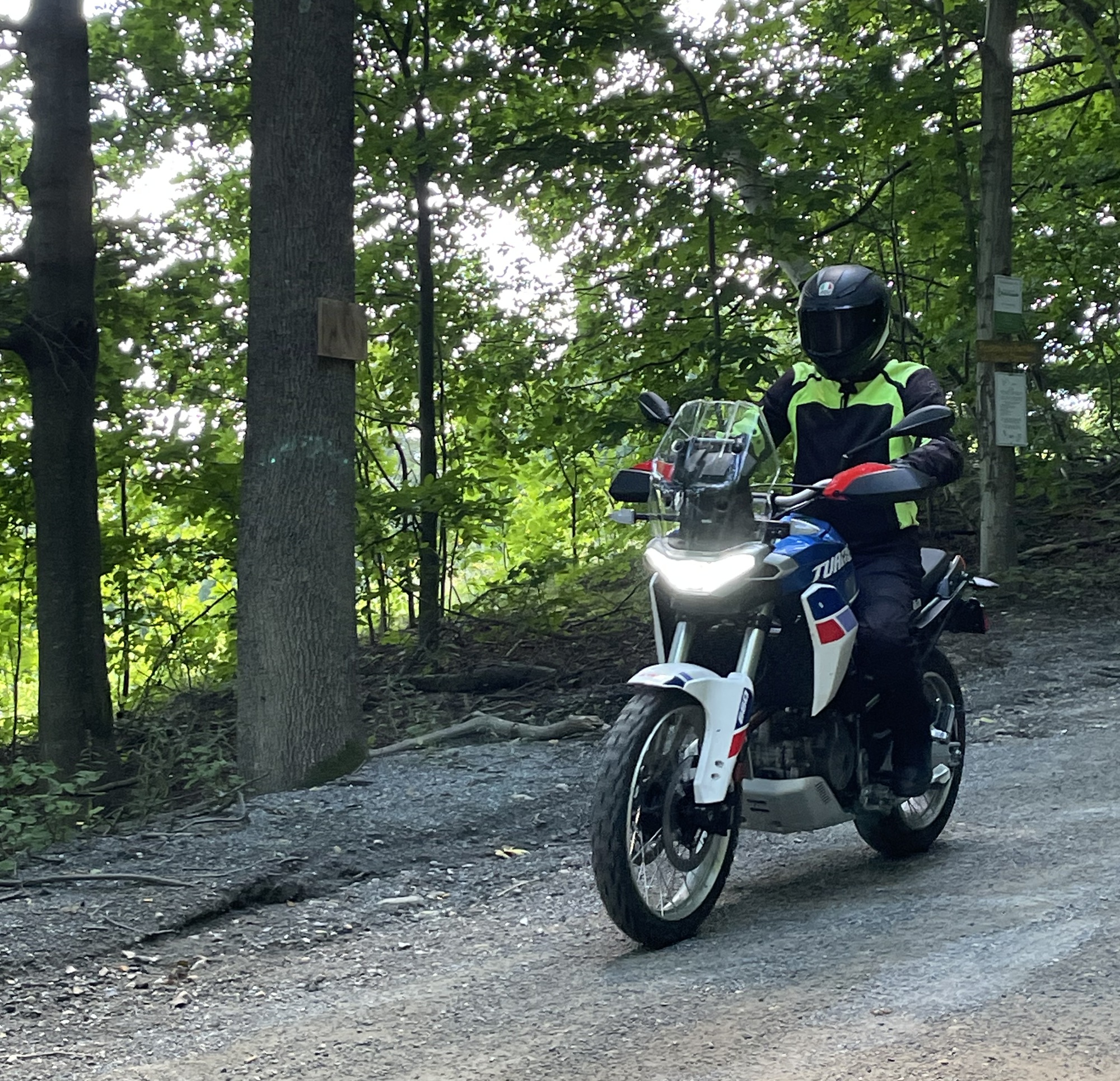
The Aprilia Tuareg, with features such as a stock skid plate and suspension that has longer travel and is fully adjustable, is more suited to off-road use. But both bikes are more than capable of handling the dirt roads that I often use as shortcuts around my home in the Berkshire Mountains of western Massachusetts. IMGA photo.
The choice, and a conundrum
If you’ve read all the above, it’s pretty easy to see that while both of these motorcycles clearly fall into the same category and have to be considered competitors, the Tuareg is shaded more toward off-road use and the Transalp leans more toward street competency, and especially for long-distance riding. So if you’re choosing a middleweight adventure-touring motorcycle, you just go for the Transalp if you’re mostly riding on the street or for longer distances and you opt for the Tuareg if there’s more dirt in your riding plans, right? Well, it’s not that simple.
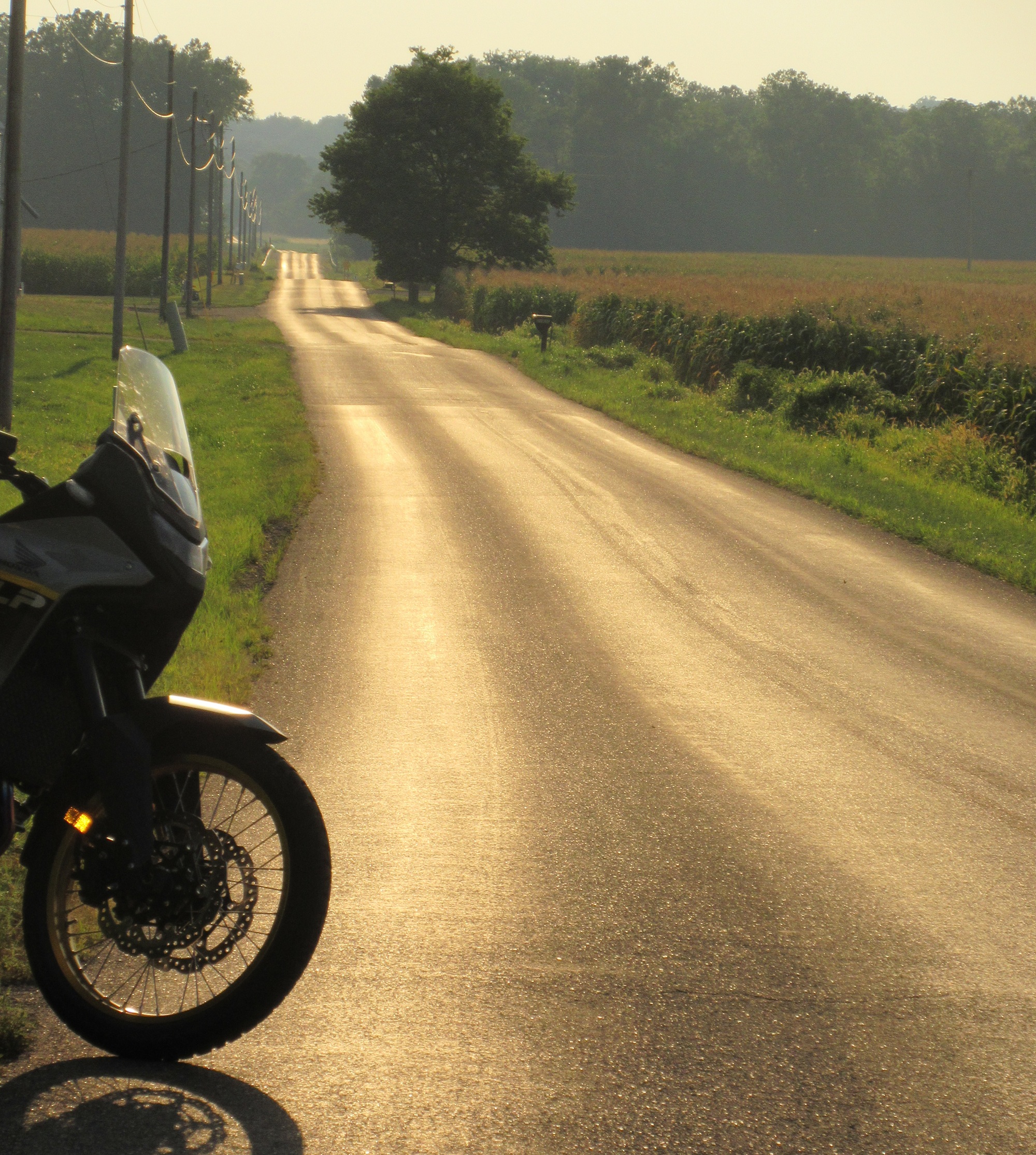
To put the Transalp’s touring capabilities to the test, I did a 615-mile day from western Massachusetts to Ohio, including everything from hours on Interstates 86 and 80 to a detour to revisit Pennsylvania Route 666 to ancient farm roads in Ohio I hadn’t seen in years. I ended the day less tired than I expected.
For one thing, these aren’t the only competitors in the class, naturally. If you’re looking at the Tuareg for its off-pavement capability, then you probably also need to consider the Yamaha Ténéré 700. Or, if you want all the Aprilia’s features at a lower price tag ($10,299, to be exact), then there’s the CFMOTO Ibex 800.
But even if we just stick to the Tuareg and Transalp, the decision is not as easy as Transalp = highway and Turaeg = dirt. While the Transalp’s better seat comfort and wind protection make it better for long-distance highway days, it is held back in that usage by the lack of two features the Tuareg offers: cruise control and tubeless tires.
Cruise control is the topic of reader debate every time we write an article over at Common Tread about a motorcycle that lacks it. Some buyers demand it on any motorcycle that even might be pressed into long-distance duty. Others are less adamant (myself included). For the record, the Tuareg’s cruise control worked very well and I used it some. I would have used it on the Transalp on some of the long highway stretches I did getting from my home in the Berkshires of western Massachusetts to the Mid-Ohio Sports Car Course for the MotoAmerica races, but I was OK without it.
Even more than cruise control, the tubed tires were another issue that was on my mind as I left for a trip far from home. With tubeless tires, there’s a pretty good chance you can plug a typical puncture and, at very least, get further down the road to a more convenient time and place to make a more permanent repair, if needed. To fix or replace a punctured inner tube, you’re going to have to carry a lot more tools and do a lot more work alongside the road, all while hoping some distracted texting driver doesn’t drift onto the shoulder and plaster you. You’ll need not just tools to remove the wheel and tire irons to remove the tire, but also a way to lift the bike. A center stand is available for the Transalp, but it’s a $199.95 accessory.
It may seem a little backwards that the more touring-capable of these middleweight adventure-touring bikes lacks the cruise control and tubeless tires that would be most useful in touring usage, but it’s easy to understand why: the price. The Tuareg costs 25% more than the Transalp. Also, another likely consideration is that Honda would like for buyers who demand those additional features to step up to the Africa Twin. But that means a minimum bump in price of nearly 50% over the Transalp, depending on which model of Africa Twin you look at, as well as more weight, a taller seat, and an overall less accessible ride.
So the decision is not as simple as you might first expect. It really depends on your budget and the features you consider must-haves. One thing that is straightforward is that these middleweight adventure-touring motorcycles are popular for very good reasons. Comfortable, capable, and arguably more versatile than anything else on two wheels, they make an appealing option for anyone whose tires ever stray from pavement.




Your experiences are simialr to mine. I have a 2021 Tenere 700. I have ridden it at off-road parks and I have ridden it from my home in the Poconos to Jersey City. I have been pleased with the STRs in both scenarios. As I needed a new rear tire, I recently ordered a Pirelli MT90 AT from ZLA. It had positive reviews so I thought I would try it out. As my Intruder was laid up until last weekend, the T700 has seen grocery/errand duty, but very little dirt, this summer. I hope to reverse that this fall. I love my ADV, even though it journeys to Shoprite or Dunkin more than the “wilds” of Pennsylvania.