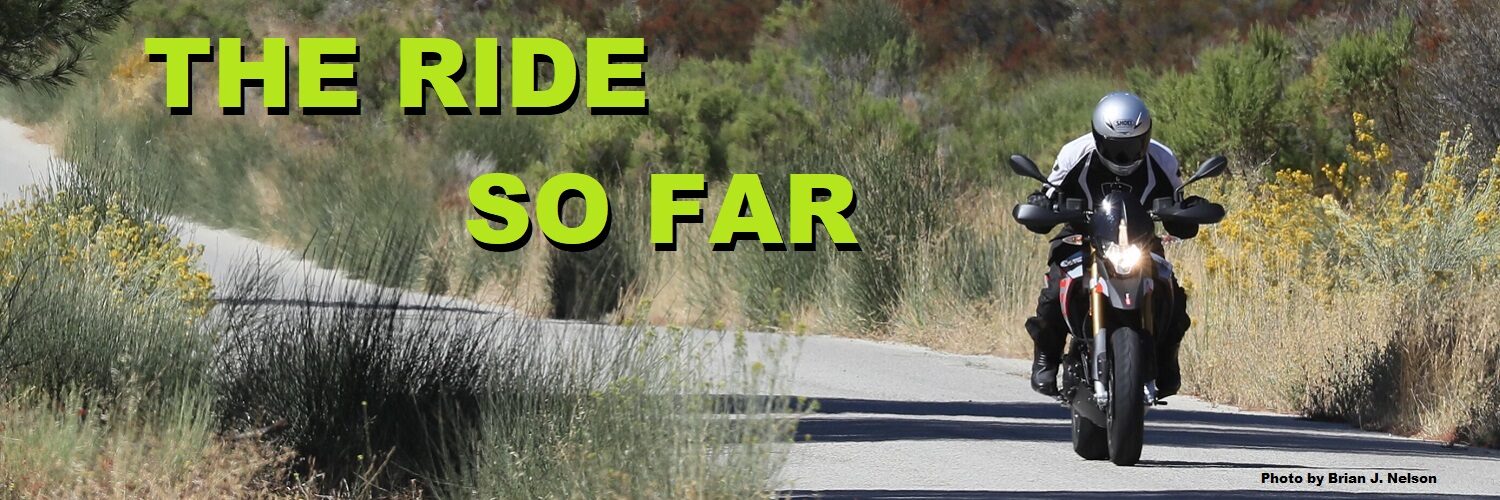
After many years of dithering, debating, and always buying something else instead, I’ve finally joined the ranks of supermoto owners.
To be clear right from the start, this is not one of the fire-spitting, high-maintenance, “ready to race” supermotos fit for competition. This is a street ‘tard. I picked up a 2021 Kawasaki KLX300SM with under 6,000 miles on it.
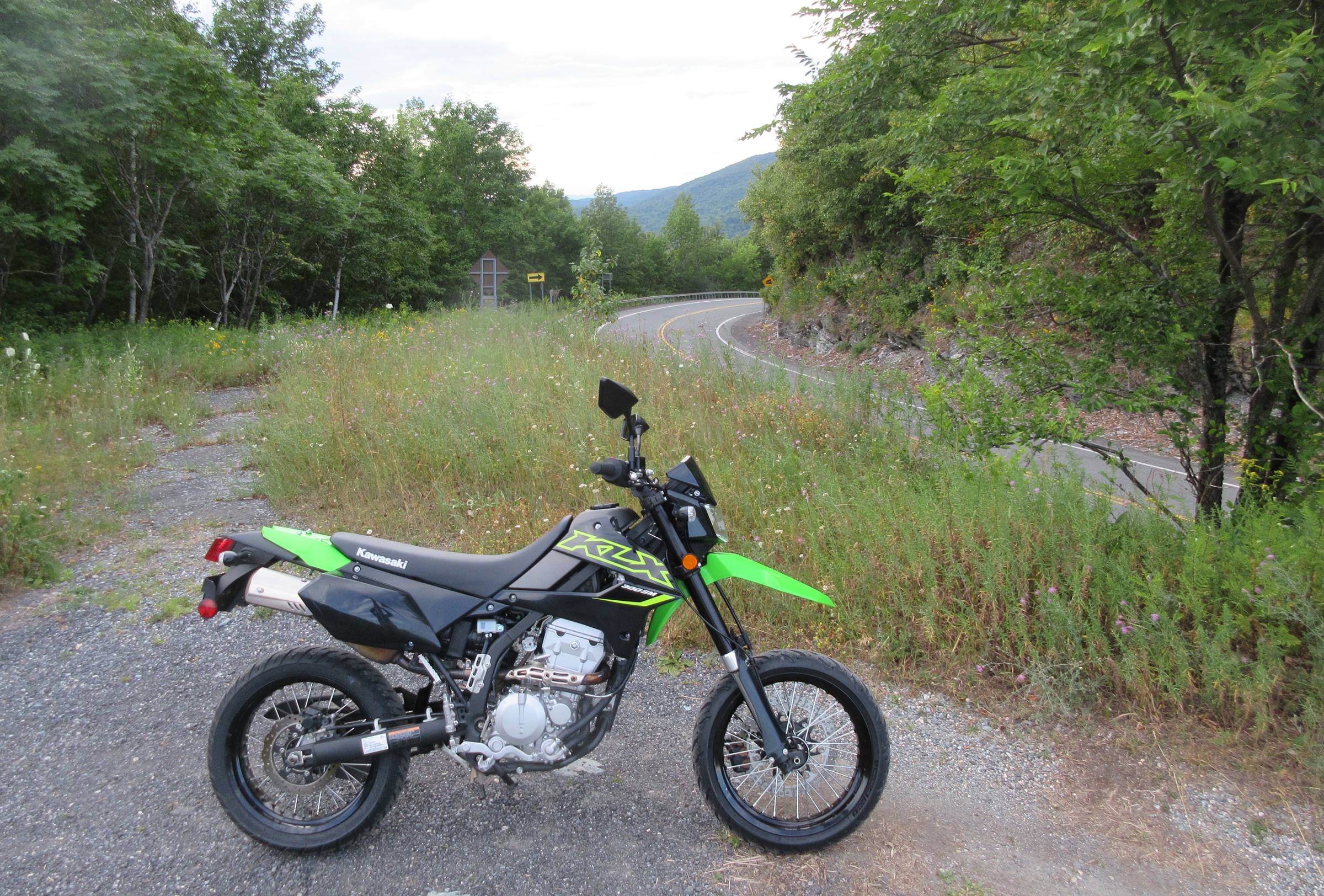
The 2021 KLX300SM I ended up buying was almost completely stock and in better condition than I expected for a two-owner bike.
I wrote about this bike in late 2020 when Kawasaki announced it. Specifically, I wrote that I was very surprised to see it. To understand why, let’s look at the underwhelming history of supermoto in the U.S. motorcycle market.
A (very) brief history of supermoto
Supermoto racing dates back to the 1970s when it was invented as a made-for-TV spectacle in the United States, to pit motorcycle racers of different disciplines against each other. It ultimately became more popular in Europe, however, where the bikes were called supermotards (thus the “street ‘tard” reference above, in case you were wondering). I was working at the American Motorcyclist Association (AMA) back in the early days of the 21st century when someone decided it would be a great idea to bring the trend back to the United States by starting a professional supermoto racing series.
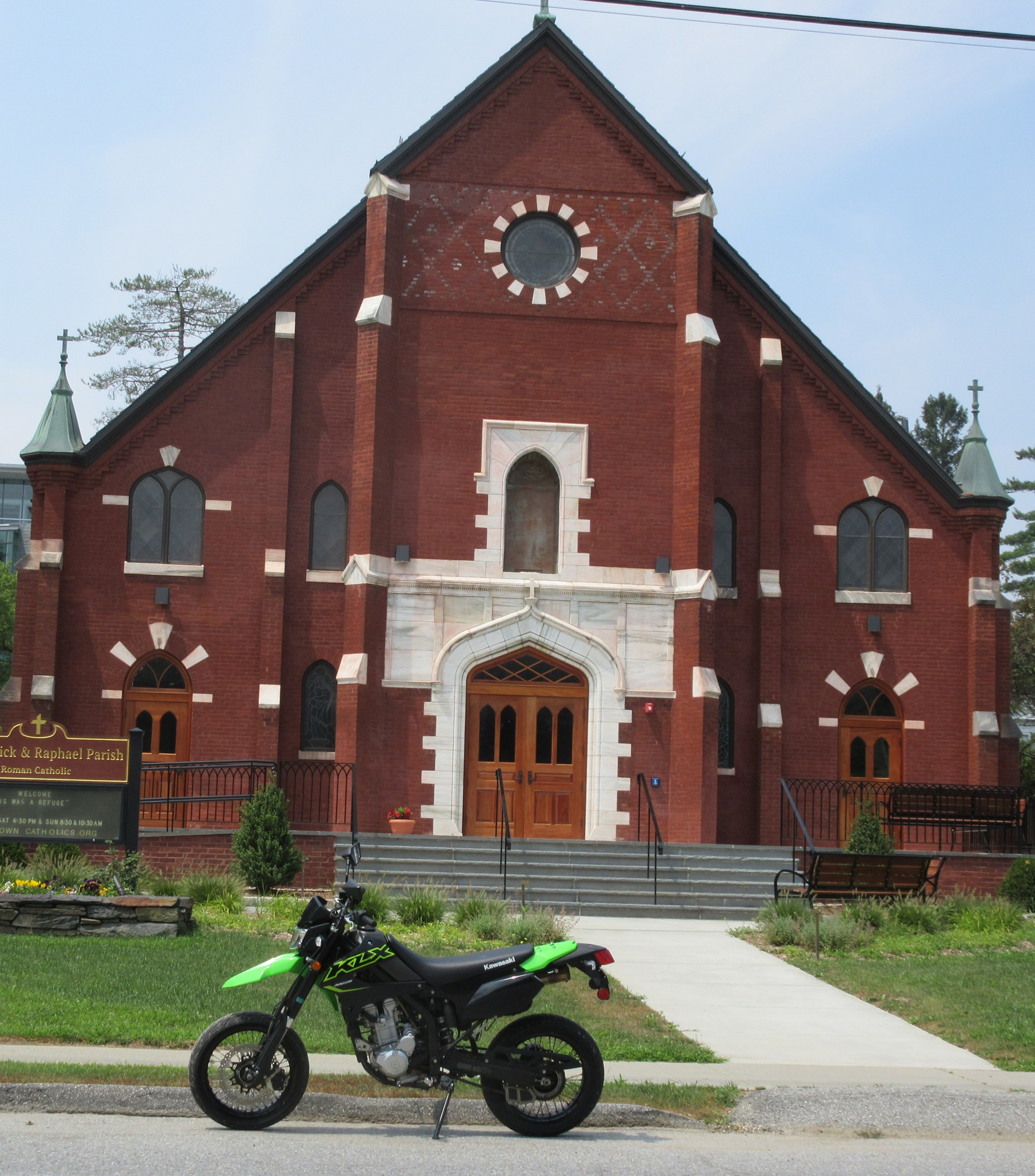
Manufacturer promotional materials typically show cruisers in gritty urban landscapes, touring bikes on beautiful, remote roads, and supermotos (when they’re seen at all) in city settings, blitzing through traffic. Not a lot of traffic in the small town where I live, but a supermoto like my KLX300SM is still ideal for local transportation.
What a great idea! While those initial race bikes, basically motocross machines with big brakes and 17-inch racing slicks, were quite trick, they were still a lot cheaper than mounting a Superbike race team. Tracks mixing mostly asphalt with a dirt section and a jump could be set up anywhere, even on a big parking lot in the city instead of some distant race track, making the racing easily accessible to more people, including potential fans beyond the already-committed hardcore motorcycle racing fans.
Even better, the idea stirred a lot of enthusiasm. Racers from various disciplines signed up, including stars such as Supercross king Jeremy McGrath, motocross champion Jeff Ward, and popular roadracer Ben Bostrom, to name just a few. It was perfect! The idea couldn’t fail.
But it did. The series didn’t last long.
Sales of street-legal supermotos in the United States didn’t do much better. The Suzuki DR-Z400SM soldiered on with a small but loyal following, often having the segment largely to itself. There was the occasional high-performance, high-cost, usually high-maintenance option from someone like Ducati or KTM. But supermoto fans remained a small but passionate niche, nearly too small to measure in the overall U.S. motorcycle market.
Still, part of me always wanted one, and when Kawasaki gave the supermoto treatment to its KLX250S dual-sport and created the KLX250SF, I was intrigued. As mentioned in that previous story, it was hard for me to walk away when I saw a line of leftover new KLX250SFs on sale for just $2,999. Considering that Kawasaki couldn’t sell the KLX250SF, I was surprised to see the KLX300SM emerge as a new model for 2021. (And later, I was even more surprised to see Kawasaki build a supermoto version of its smaller KLX230.)
For more than a year, I’ve been considering buying something lightweight and used for my local transportation and for exploring the small, often unpaved back roads of the Berkshires here in western Massachusetts. I still have fond memories of the Honda NX250 I bought more than 20 years ago, humble and unimpressive though it was. For the simple purpose of zipping around for local transportation, in my opinion it’s hard to find something more easy to ride yet versatile, more practical yet fun, than a 250-class dual-sport motorcycle. Add to that the number of dirt roads around my current home and it seemed to make perfect sense. I started looking at used Honda CRF300Ls and Kawasaki KLX300s, but until recently sellers were still dreaming of post-pandemic pricing for dual-sports, and asking prices were ridiculous. That has come down to something closer to reality, finally, but in the meantime I got custody of the company-owned BMW G 310 GS, aka “Baby Shark,” and that met my needs just fine.
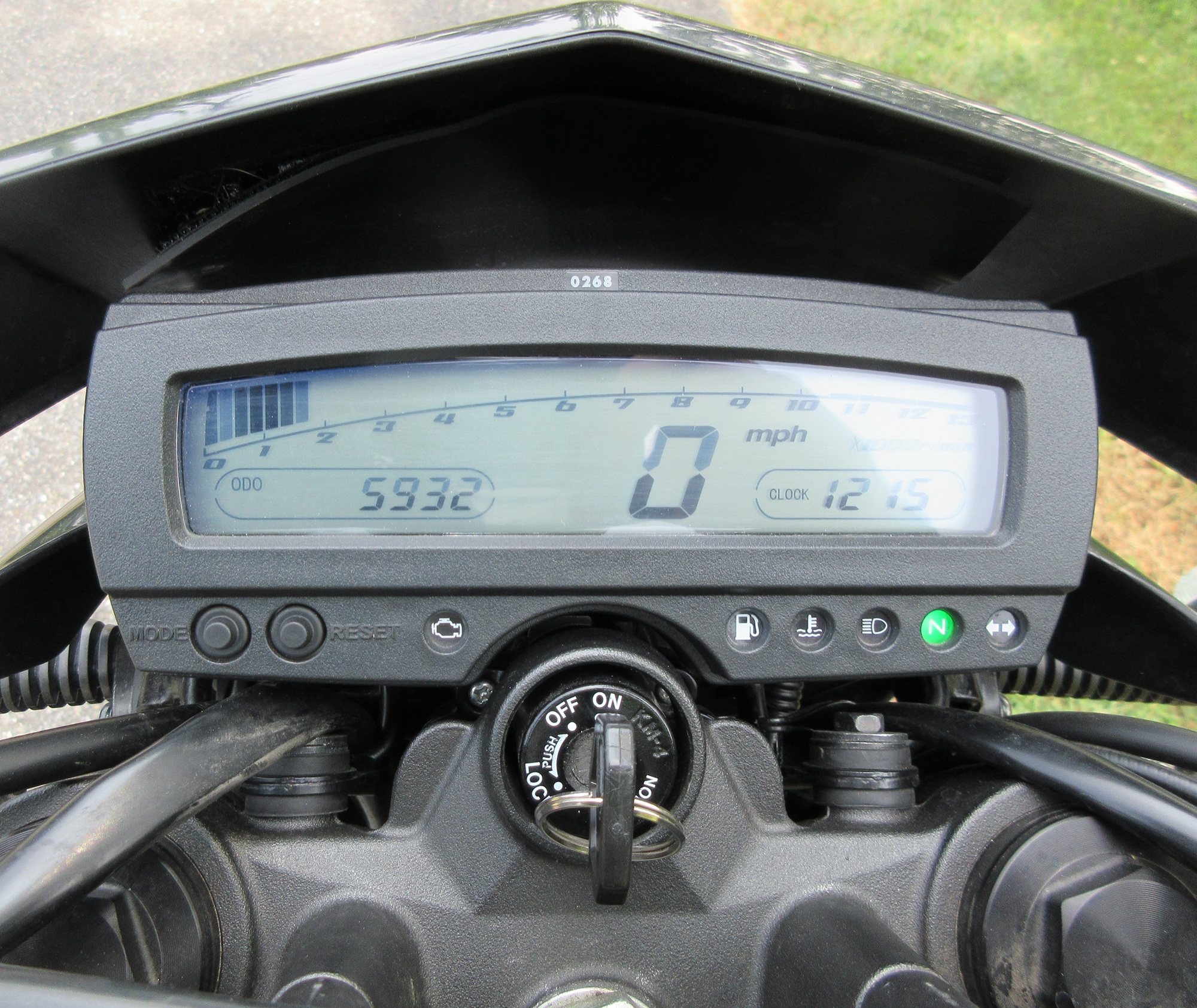
We recently ran an article on Common Tread looking at whether the proliferating features on modern motorcycles and their increasingly complicated TFT displays are becoming a distraction. No such worries with the LCD display on the KLX300SM. There’s a bar tachometer across the top, speed readout in the center, clock on the right, and odometer with two trip meters on the left. That’s it.
All the while I was looking at dual-sports, however, I kept considering the KLX300SM. Though very similar to its KLX250SF predecessor, it had two advantages: an extra 43 cc of displacement and, most importantly, fuel injection. KLX250 owners were forever trying to get their carburetors tuned just right. The supermoto version of the KLX made sense for me, after all, because the vast majority of my riding is on pavement and when I am on dirt, it’s a maintained dirt road, not a rocky hillside or sandy trail. Lately, no fewer than four listings for used KLX300SMs popped up within 100 miles of me, which gave me a bit of bargaining leverage, and I ended up buying one from a guy who lives about 10 miles from me.
Initial impressions? While I love setting off on a long trip on a comfortable, capable motorcycle, for day-in, day-out riding, I also love having a small, lightweight motorcycle in the garage. They’re just so simple to ride. For a few years, after I inherited my mother’s Suzuki GN125, that little bike served the purpose, but it was significantly limited by its minimal power and inability to do highway speeds. The most common complaint about the KLX300SM is that it, too, needs more power to live up to the supermoto image. But while it would definitely be more fun if it were, say, 400 cc instead of 292 cc, it’s capable of keeping up with traffic on any road, which makes it a lot more versatile. Plus, despite its street tires, on dirt roads the lightweight KLX300SM inspires just about as much confidence in this not-so-experienced off-road rider as the BMW G 310 GS with its more dirt-worthy tires but a little more weight. The KLX300SM’s stiffer suspension gets a little angry over some of the worst ripples on those dirt roads, but because it’s adjustable, unlike the BMW’s suspension, I can always soften it up if I want. That’s what the previous owner had done, but I put the suspension back to the stock settings to start, so I’d have a baseline of sorts.
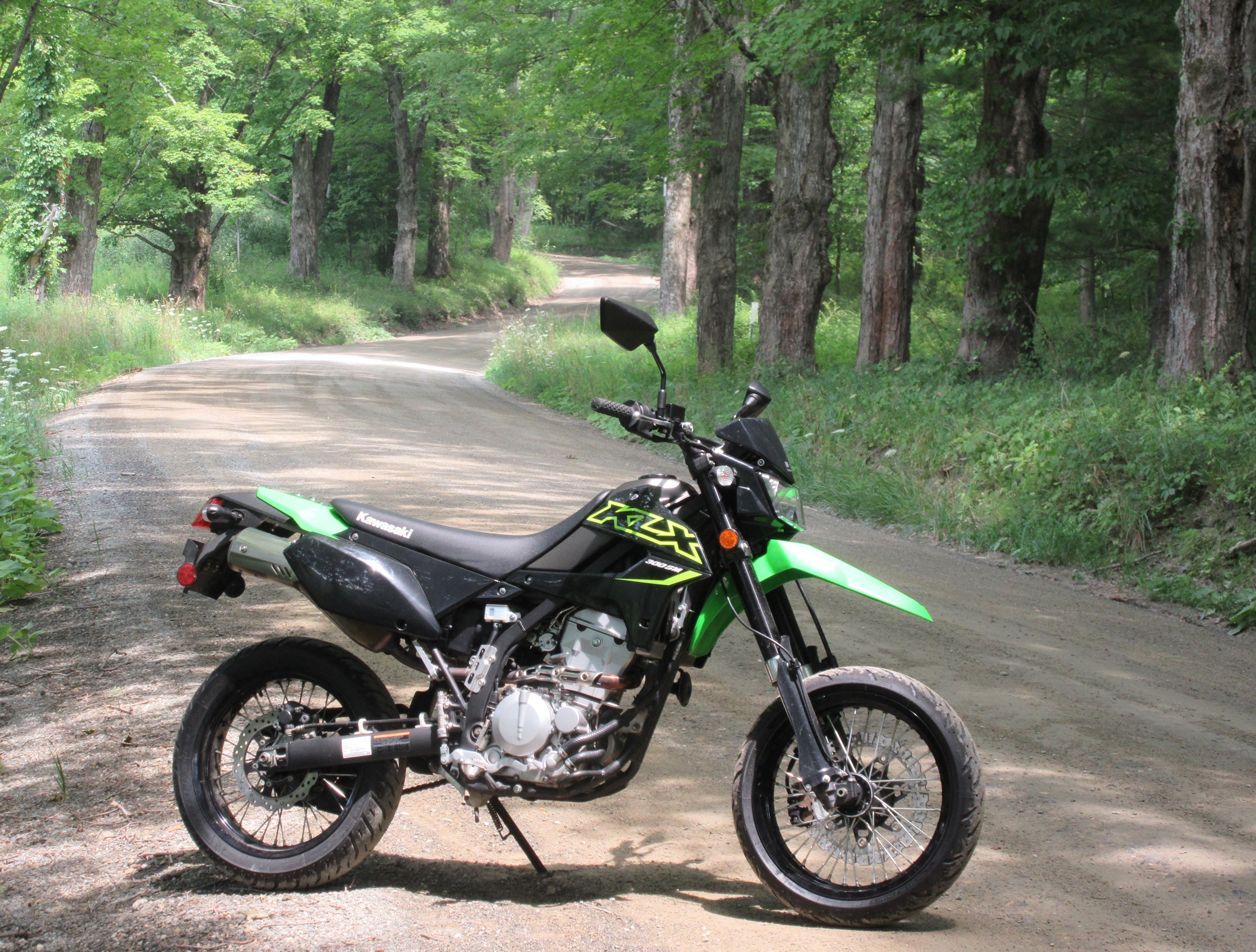
While I don’t actually do any trail riding, the small-town area where I live in the Berkshires has lots of dirt roads, ranging from useful shortcuts to pleasantly scenic alternate routes. That’s one reason I kept considering a dual-sport. But the supermoto handles roads like this just fine.
For some people, the best part of motorcycle ownership is accessorizing and “fixing” all their machine’s issues. These farklehounds are the reason you can sometimes find bikes for sale with low miles but lots of extras because they spent more time customizing than riding. I’m at the other end of the spectrum and usually keep my machines close to stock, but the KLX does need a few things. As it sits, there’s almost no way to carry anything, and since its job is to be practical transportation, it needs to be able to bring home some groceries now and then. To that end, I’ve ordered a Precision Motorcycle top rack. Before winter, I’m going to put on some handguards, just for weather protection for the weakest link in my cold-weather riding. If I find a reasonable solution for some wind protection for my upper body that isn’t terribly awkward or ugly, I may add that for winter, too.
Of course this purchase does nothing to replace the 2014 Honda VFR800 Interceptor Deluxe I sold earlier this summer. As much as I enjoy the simplicity of the KLX300SM around town, I wouldn’t want to go far on it. Sure, it will do 70 mph, but it’s buzzing a lot as it does it, and the typical dirt bike seat feels remarkably like a two-by-four wrapped in thin vinyl. The VFR’s role was for trips, and sooner or later I’m going to need to buy a replacement for it that’s suitable for long-distance travel. Fortunately, for the trip I have planned for August, I’ve been able to line up a loan of press bike from Honda.
Replacing the VFR is a story for another day. For now, I’m bopping around town on my supermoto. Finally.




So does this mean you aren’t still wondering why supermotos are too expensive?
I assume you’re referring to this previous article: https://theridesofar.com/2023/06/why-are-supermotos-so-damn-expensive/
Fair point! I do still think supermotos are overpriced, and my best piece of evidence is the fact that Kawasaki still wants more for a new KLX300SM than for a new Z500. The latter is not only more capable, but has a lot more parts, so it has to cost Kawasaki as much to build as the supermoto.
There are two mitigating factors, however. One, the pricing issue is why I bought used. While the KLX supermoto and dual-sport start out with the dual-sport being less expensive, the dual-sport holds its value better and the supermoto falls faster in price due to used-bike depreciation. So over time, the supermoto becomes a better deal. And second, I’ve somewhat rationalized the high supermoto prices by saying that you do get something for the money. What you get is light weight. The Z500 does give you more power and it has features such as ABS that the KLX300SM lacks, but the lighter supermoto provides a different riding experience. One that’s not necessarily better for everyone, but perferrable to me.
Congratulations! To your point about the pricing, the better suspension on a supermoto costs a lot more money than what is generally used on other bikes. Take a look at the cost of upgrading the suspension on Honda’s CRF300L, for example, it’s going to be at least $1500 to make it remotely comparable with some other bikes of this type from the European manufacturers; it would be at least $2k and probably more, to give a Suzuki SV650 comparable suspension to the DRZ4S. The easiest place to keep the price down on bikes is the seats, brakes, and suspension, and it’s exactly what you usually find on lower cost models.
Kawasaki can only keep reasonable pricing on the KLX by using a chassis and engine designed in the 1990’s, and building it in Thailand (I think that’s where they’re built, not positive on this). I’m actually surprised they even updated it at all, since they can’t sell this bike in Europe, a much larger market than ours.
Looking forward to hearing more about your ownership experience!
Those are reasonable points about comparing the supermoto to the pure street bikes, in terms of the cost of the suspension. But what about the $400 price difference between the KLX300 dual-sport and the KLX300SM? No real difference in suspension and the parts on the two that are different are roughly the same in cost. Suzuki used to do the same with the DR-Z400S and DR-Z400SM, asking $700 more for the supermoto though they were very similar. Suzuki has changed that with the new DR-Z4S and DR-Z4SM, charging the same price for both, but for years there has typically been a price difference between the dual-sport and supermoto versions of the same model.
Like you, I was really surprised Kawasaki brought back the supermoto, which is why I wrote that earlier article on that topic. And straying a bit further a field, I’m even more amazed they introduced a supermoto versions of the KLX230.