It’s the stuff of post-ride conversations around the campfire and the origin of one of the most common jokes in motorcycling. The question: What’s the perfect number of motorcycles? How many do you need?
The well worn joke, of course, is that the answer is always n+1, where n is the number of motorcycles you currently have. And while there may be some universality to the sentiment behind that saying (haven’t we all looked upon another motorcycle with lust, even when we’re happy with the ones we have?), the truth is that, like everything else in motorcycling or life, there’s no single answer that fits everyone.
Some riders are perfectly happy with one. It does what they want to do and what’s the need to complicate things beyond that? I know another guy who lives up the road from me who for many years ran a successful business in the motorcycle industry. He has a barn on his property with many motorcycles in it. Ask him how many and he’ll look sheepish, hesitate a while, and say he honestly doesn’t know. Triple digits, for sure.

Sometimes, a personal collection of motorcycles grows to the point it only makes sense to turn it into a museum. Such is the case with Motorcyclepedia.
It’s easy to understand why some people, by nature, are collectors. Another guy I used to work with spent much of his career working in motorcycle museums. I went to his house one day and we walked into an old shed in the back yard that was the size of a two-car garage. At the back was basically a large, sturdy shelf and the entire width of the building, both the ground and the raised shelf, were lined with tightly packed motorcycles, each under a protective cover. It was his collection. Personally, having a collection of a few dozen motorcycles that I couldn’t easily see or touch, much less ride, would bring me no joy whatsoever. But he was a professional museum manager. He was the current caretaker of these machines, for now. Just knowing that he had them, that he’d preserved them, gave him joy.
But how many motorcycles do you need to ride?
But setting aside the collectors, what about those of us who have motorcycles for the purpose of riding them, not preserving them?
One of the best known opinions on the topic comes from one of the best known writers in motorcycling. In his regular column in Cycle World magazine, Peter Egan addressed the issue nearly 30 years ago in a piece entitled “How many bikes do you really need?”
Egan’s conclusion? You need five. A sport bike to enjoy the performance motorcycles can provide. A comfortable and capable sport-touring bike for when you want to go the distance. A dirt bike, in the broadest sense, meaning anything from a small dual-sport to an adventure-tourer, so you won’t stop when the road turns to dirt. A “great big hog of some kind,” in Egan’s case a Harley-Davidson Road King, for when you want a relaxed ride and to be able to carry whatever. And an “old crock,” something from the past, something from your youth, or something that is simply beautiful to you. A sentimental choice.
Five was the limit for Egan. Beyond that, he felt he had too many and some were essentially neglected. But even when he wrote that column, he admitted that his current collection didn’t fit that five-bike ideal. He also admitted that he was prone to accumulating more than the recommended personal allotment of “old crocks.”
As I said above, there’s no single answer to fit everyone, or even everyone other than the collectors. Egan’s five, for example, make sense if you want to do those five kinds of riding. Not everyone does. Some riders have no interest in exploring the performance envelope on a sport bike. I, personally, do not have any need for a big, heavy hog for relaxed rides, because I can do a relaxed ride on any bike and enjoy it more without the extra baggage. Some riders also love wrenching, but those who have no interest in the labor or expense needed to maintain an “old crock” can skip that one.
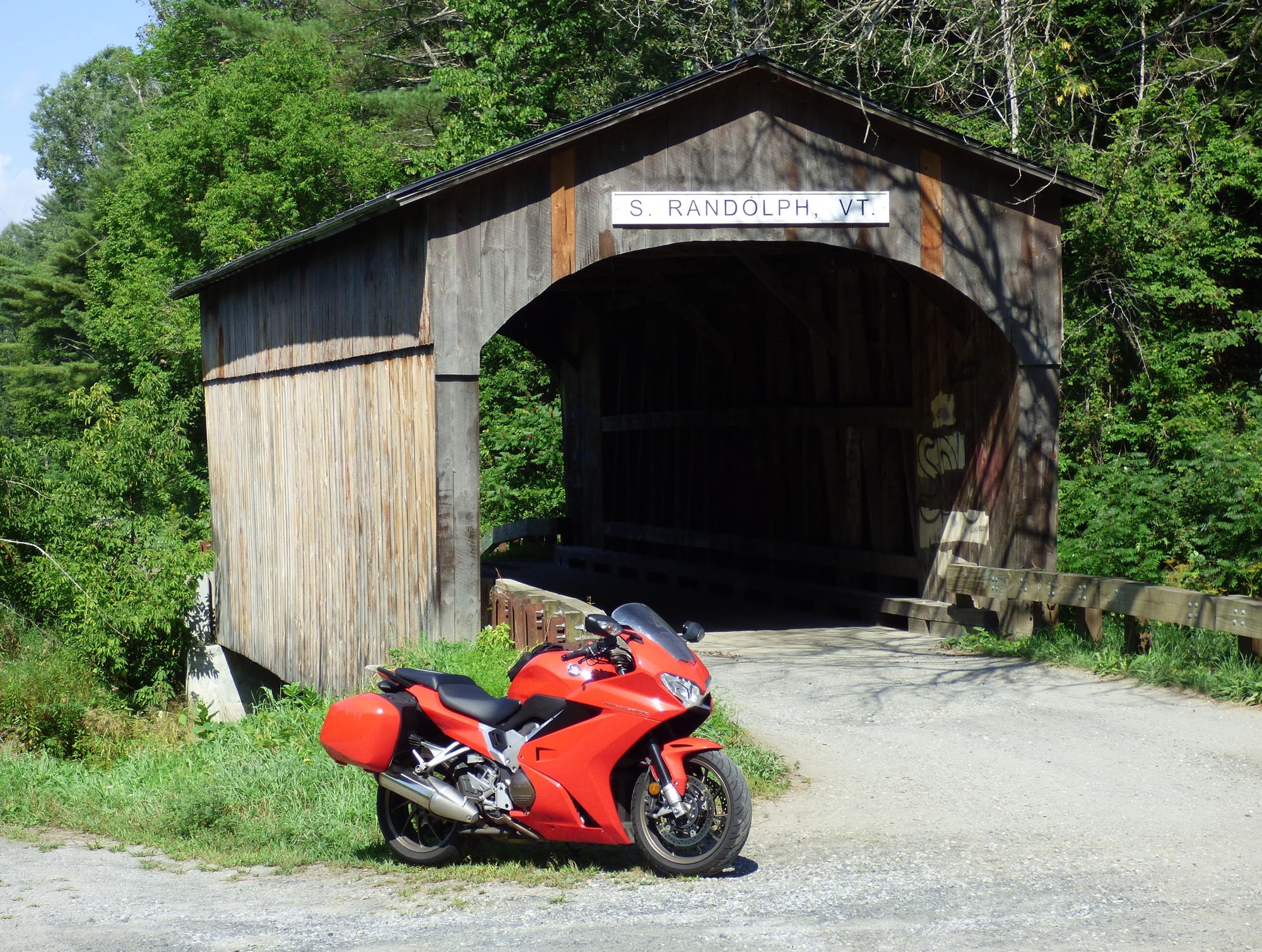
Since I sold my Honda VFR800 Interceptor Deluxe last year, the missing puzzle piece in my garage is a capable touring motorcycle.
For my own garage, and my own personal philosophy on the approach to life, which is to choose the simplest tool for the job that works, I basically reverse-engineer the question. I start by asking how many kinds of riding I really want to do and then I set about determining what’s the minimum number of motorcycles that will enable me to do all those things without undue sacrifice or difficulty.
So what do I want to do?
- I love taking at least one or, more likely, several long, multi-day trips per year, plus some day-long rides to destinations of interest.
- Despite living farther north than I ever have before, and further than ever from my past tropical climates where winter riding was the same as summer riding, I want to continue to ride at least a little all year around.
- I haven’t owned a car in many years, so while I do have access to my wife’s car, and she makes me drive it sometimes, I use a motorcycle as my primary form of personal transportation.
- I don’t do as many track days as I used to, but I’d like to do one a year, or a refresher training course such as Ken Condon’s Non-Sportbike Training Days (see my report at Common Tread), every other year.
So for me, I feel like three motorcycles is the right number because that would cover all those uses. For a while I had four, but that was the result of circumstances, not a plan, when I inherited my mother’s old motorcycle after she stopped riding and my father died. I’ve also temporarily had four in the garage on other occasions when my three were joined by a motorcycle I was testing for Common Tread. But basically, where Egan felt that more than five inevitably meant neglecting at least one, I feel that anything more than three amounts to more motorcycles than I can ride as regularly as I want to. Beyond three, I sooner or later feel bad for the one neglected in the corner of the garage.
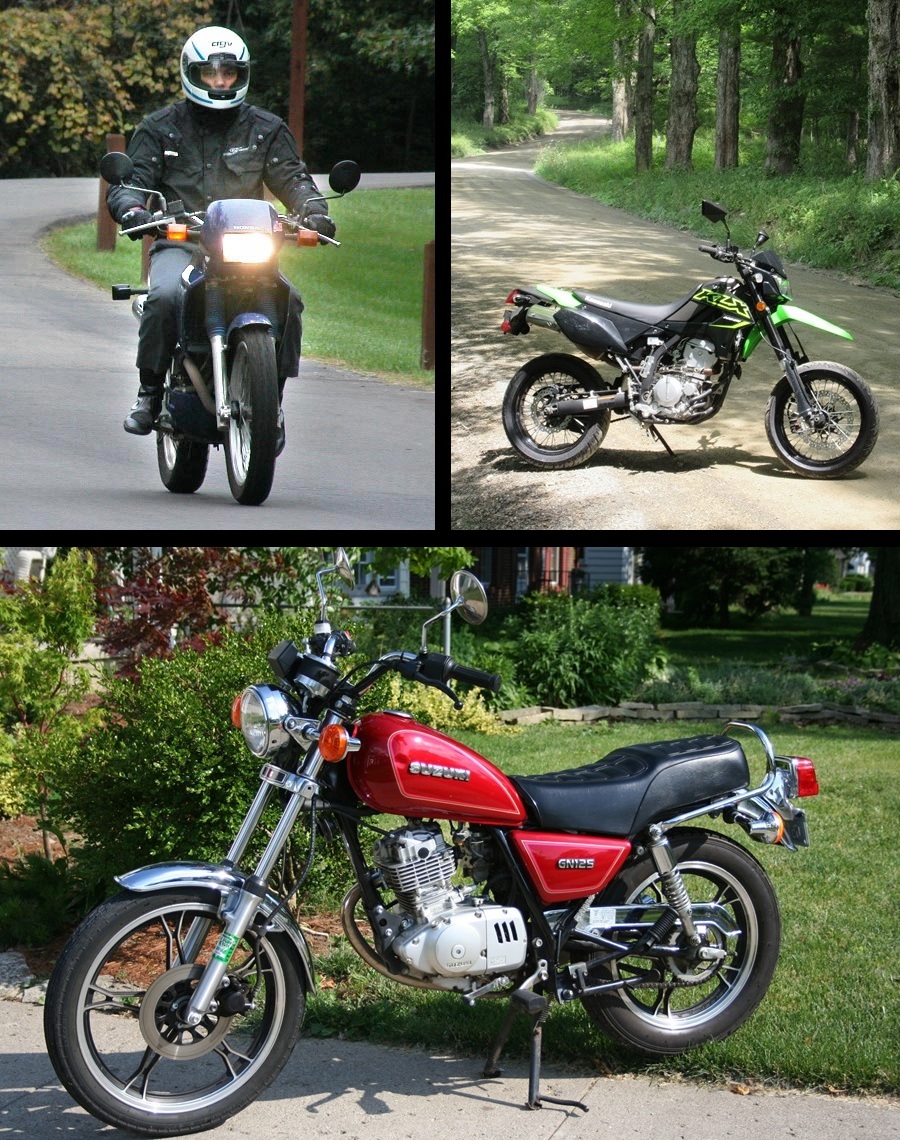
While I don’t buy and sell like some do, several motorcycles have come and gone over the years. I always like having one small motorcycle in the rotation for quick, easy, and cheap transportation. More than 20 years ago, the Honda NX250 (top left) was the perfect rat bike, inexpensive enough that I didn’t mind riding it in winter conditions. Today, the Kawasaki KLX300SM supermoto (top right) fills those functions, is more fun to ride, and is capable of handling both highway speeds and dirt roads. For a few years, I rode the Suzuki GN125 (bottom photo) I inherited from my mother, before I handed it down to the next generation.
Now if I owned no motorcycles and was assembling my three-bike garage, it would be simple. I’d blow the biggest part of my budget on a reliable, comfortable sport-touring motorcycle with wind protection and luggage that I’d use for my long trips. That would cover the first bullet point above. Then I’d buy a cheap, used, 250-to-300-cc-class dual-sport to cover bullet points two and three. Where I live now, in the Berkshires of western Massachusetts, there are lots of pleasant dirt roads that make for interesting exploring and sometimes scenic shortcuts. Plus, a dual-sport is easy, fun, economical transportation for just getting around town and running errands. It would also be my winter bike, and I’ve argued before that a dual-sport is a good choice for the rat bike that every motorcyclist needs, as well as a good option for urban transportation. Then what’s left of my budget would go to a sporty naked bike that would be fun to ride for mid-range duty and plenty capable enough to take to a track day, especially a Non-Sportbike Training Day.
Of course unless a meteor strikes your garage and you get an unusually generous settlement from your insurance company, we are never in the position of assembling the ideal lineup from scratch. Instead, we’re replacing one with another, usually blurring the lines between use cases. In my case, my complicating factor is that I have an “old crock” I never intended to have. But I earned it the hard way. I still have my 1997 Triumph Speed Triple that I bought lightly used in 1998. And now I couldn’t imagine parting with it until death do us part (either mine or the motorcycle’s).
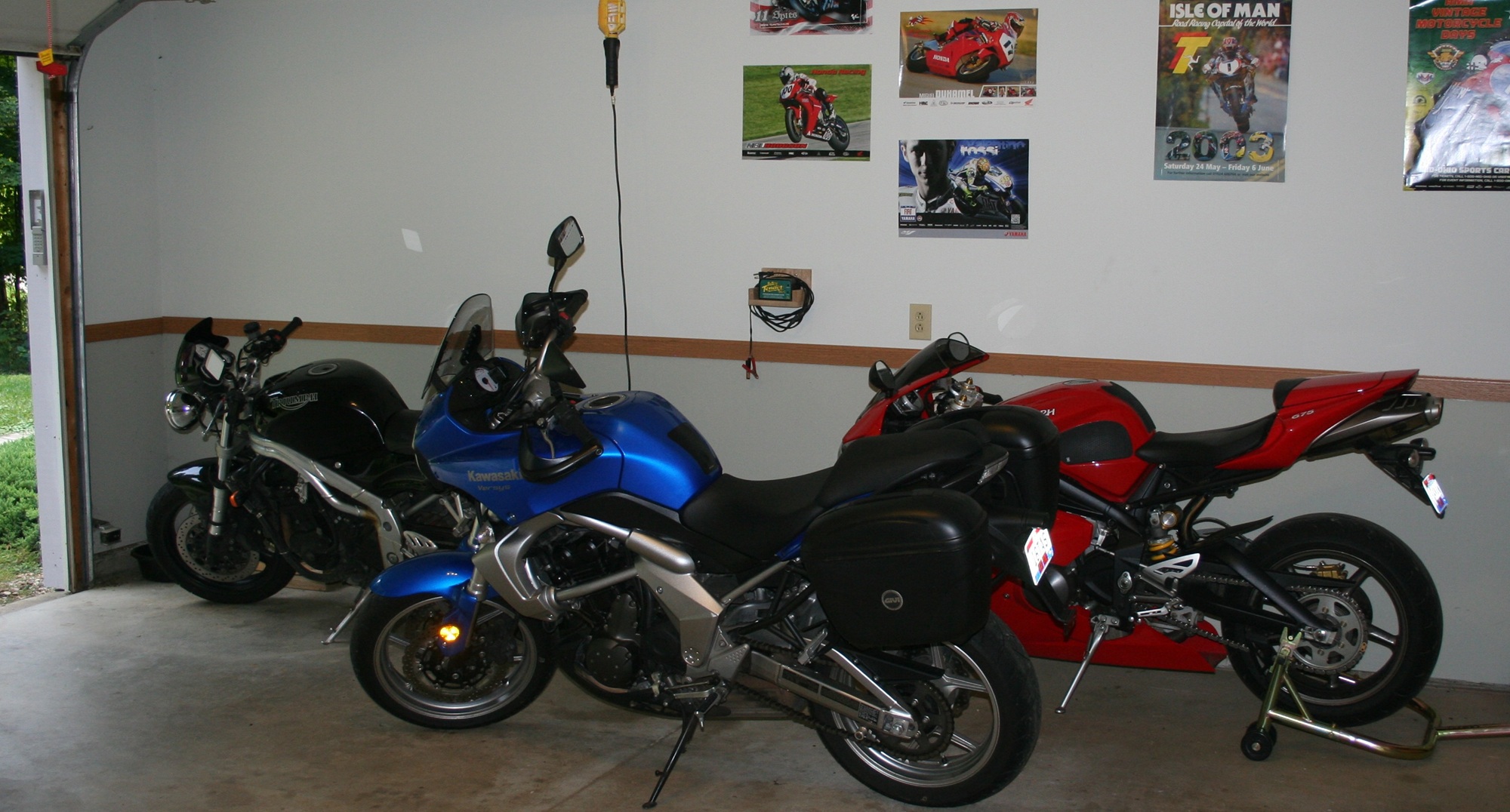
For a nine-year period, I had total stability in the garage: The Kawasaki Versys I set up as a lightweight sport-touring motorcycle, my Triumph Daytona 675 used for track days and sunny weekend rides, and the Triumph Speed Triple, which was much younger then but already around 80,000 miles on the odometer. A good lineup, but none of them were a good winter rat bike.
The thing is, the Speed Triple these days, with 124,000 miles on the odometer and a broken thermostat that’s no longer obtainable, doesn’t fulfill any of my bullet points. Riding it in the winter feels like abuse, taking it to the track would be nearly the same, and although I love it, I don’t trust it enough to roam a couple thousand miles from home aboard it.
Last year, I sold my 2014 Honda VFR800 Interceptor Deluxe and bought a used 2021 Kawasaki KLX300SM. While the little supermoto is not really the dual-sport in my ideal three-bike garage, it works just fine on the kind of off-pavement (not really off-road) riding I do so it meets bullet points two and three. But I still need to buy a replacement for bullet point one. And can I find one bike that’s comfortable enough and sporty enough to cover both bullet point one and four?
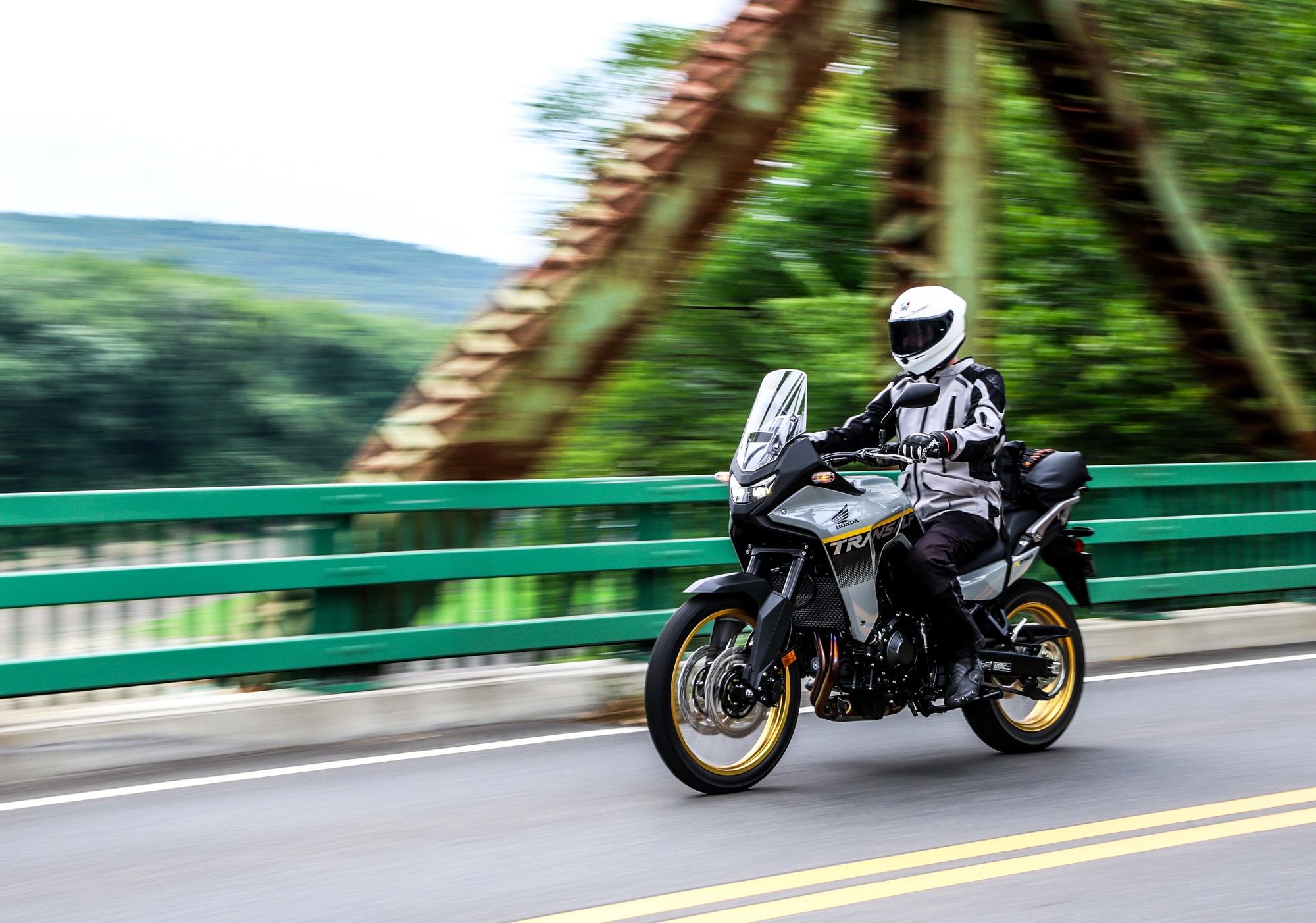
In 2025, I filled in the absence of my VFR800 sport-tourer by using borrowed press bikes, such as this Honda Transalp I took on a trip to Ohio. But this year I plan to get a permanent replacement. Photo by Todd Verlander.
After filling in the VFR800’s absence in 2025 with test bikes, that’s my task for 2026: To fill out the third and most critical element of my ideal three-motorcycle garage and get back to my happy equilibrium.
Three. That’s the number for me. It’s probably different for you.




Three would be enough for me too but then I spot a deal I can’t pass up and pretty soon I have five in the garage. Then last year a good friend of my father who was kind of like an uncle to me passed due to cancer and his wife wanted me to take his 2000 Road King. Do I need this big old bike that takes up more than its share of space in the garage, no but how could I say no.