To many people who have never ridden a motorcycle or had any interest in motorcycles, they’re pretty much all the same, right? In some cases, the non-motorcyclist may at least discern between the stereotyped categories, “Ninjas and Harleys.” Or maybe they’ll recall that dirt bikes exist, too.
By contrast, in the community of enthusiastic, passionate, and committed motorcyclists, we have the very un-community-like habit of dividing ourselves into warring factions, calling each other pirates or power rangers, disparaging anyone who does it differently from the way we do it. That’s one of the worst parts of motorcycle culture.
But then there’s the kind of motorcycling contrast that’s good, because it fosters learning. And better skills. Professional racers call it cross-training, and they know from experience that it makes them better riders. That’s why the best roadracers in the world train on motocross bikes or race flat-track for fun. Sliding constantly in the dirt builds the ability to handle the much higher stakes of a slide on asphalt.
Even for us humble street riders, mixing it up can be a revelatory experience, a good way to refresh our skills, and simply fun — injecting some variety into our motorcycling lives. Lately, I’ve been switching between two machines that are both clearly motorcycles, but are so different in the way they behave that riding them back to back is unmistakably not the same experience.
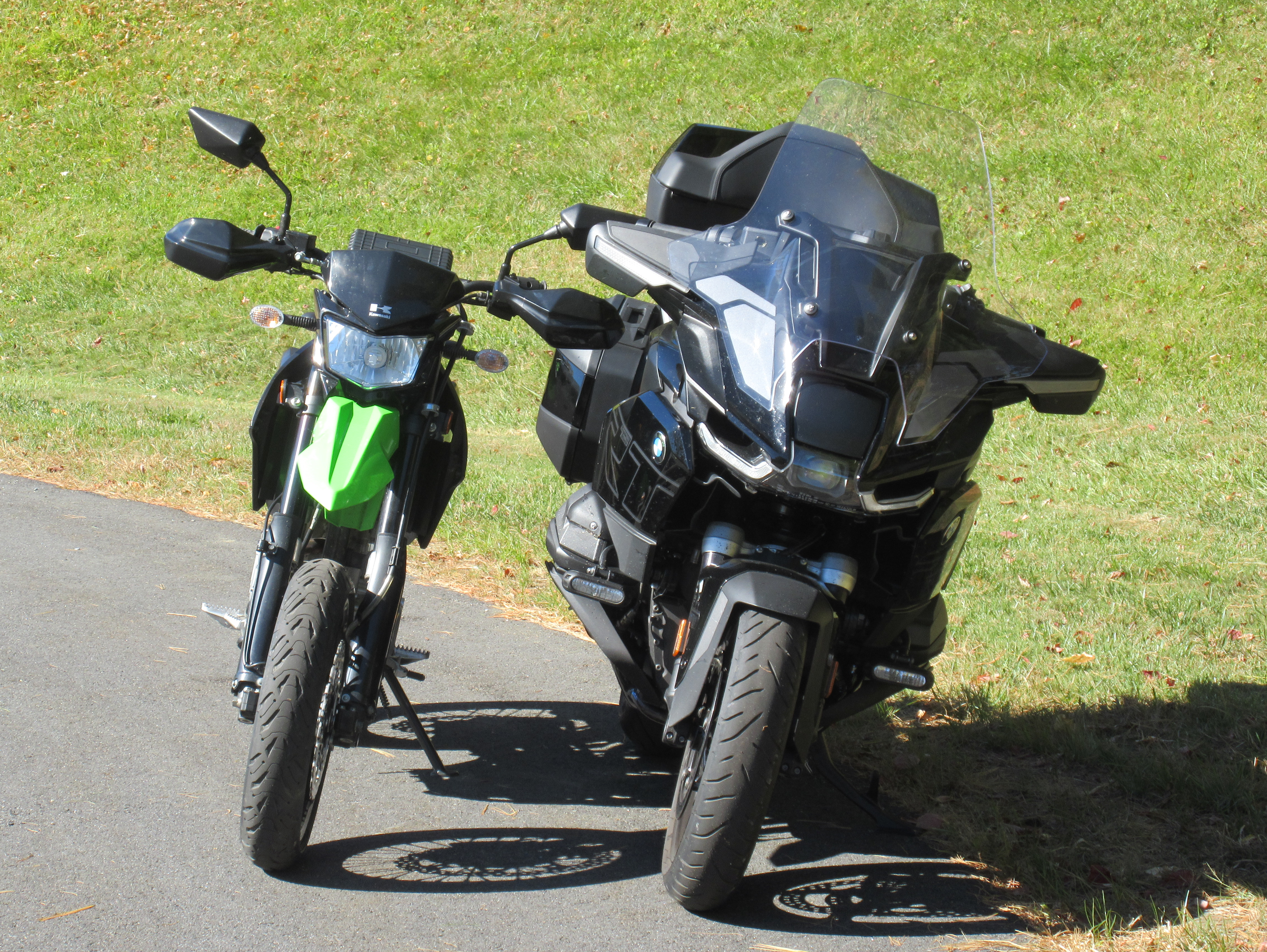
They’re both motorcycles, but the riding experience is quite different. As you’d expect.
I recently spent two days on a 2026 BMW R 1300 RT on a media ride from Greenville, South Carolina, to the beautiful Barber Motorsports Park in Alabama, where the Barber Vintage Festival was underway. Then I rode the big BMW (see my full review at Common Tread) home to western Massachusetts, where the 2021 Kawasaki KLX300SM I bought this summer was waiting in the garage. The differences — and not just in dimensions and looks — were instructive.
After a week and about 1,800 miles on the R 1300 RT, I fired up the KLX300SM for the first time in quite a while and the contrast was stark.
The BMW weighs about 650 pounds as equipped and the Kawasaki weighs just over 300 pounds. The RT is powered by a sophisticated opposed-twin boxer engine with variable valve timing making 145 horsepower and the supermoto puts out about 25 horsepower from its relatively straightforward single-cylinder engine. The BMW, as tested, lists at $31,675, and the Kawasaki, when it was new, listed at $5,999 and I paid $3,800 for it used.
The two are even more different than those numbers imply.
The R 1300 RT is a flagship bike, laden with every feature you can imagine on a motorcycle today. Its radar-informed cruise control will slow the motorcycle automatically to maintain a set distance from the vehicle ahead on the highway and speed up again when the space is clear. It has no clutch lever because the clutch is automatic. And it produces shifts that are smoother than the best ones I can manage with a manual clutch after a few decades of practice. Or, if I switch modes, the BMW will also shift gears for me. The KLX does none of these actions for me.
The BMW electronically adjusts the suspension settings, depending on the ride mode I’ve selected, and even alters the rear suspension height to create sportier geometry if I use the optional Dynamic Pro mode. The Kawasaki does have adjustable suspension — its one feature that isn’t basic — but I’m crawling around on the floor with a screwdriver to do that job.
The R 1300 RT looks after my comfort with its generously sized and electrically adjustable windscreen, along with other bodywork designed to manage airflow, plus its heated grips and heated seat. The KLX300SM? Its only wind protection consists of the handguards. And I added those myself. They’re optional accessories.
The BMW’s 10.25-inch full-color TFT display is state of the art and I can use it to delve into menus for a variety of information or to adjust various settings. If I want, I can set a reminder and it will tell me when I’m due for a coffee break on a long trip. A little coffee cup icon on the dash marks the time since my last break. The little supermoto at least has a digital dash, but it’s a dated LCD and it displays the barest of bones of information. It won’t tell me what gear I’m in, how much fuel is left, or the air temperature, and there’s nothing to report about ride modes or traction control levels or whether ABS is activated because none of those things exist. The Kawasaki does have its own method of letting me know it’s time for a break, however. If I ride more than half an hour, its seat, which feels like a four-by-four piece of lumber covered in vinyl, will put me in enough discomfort to suggest a stop.
There’s more, but you get the point.
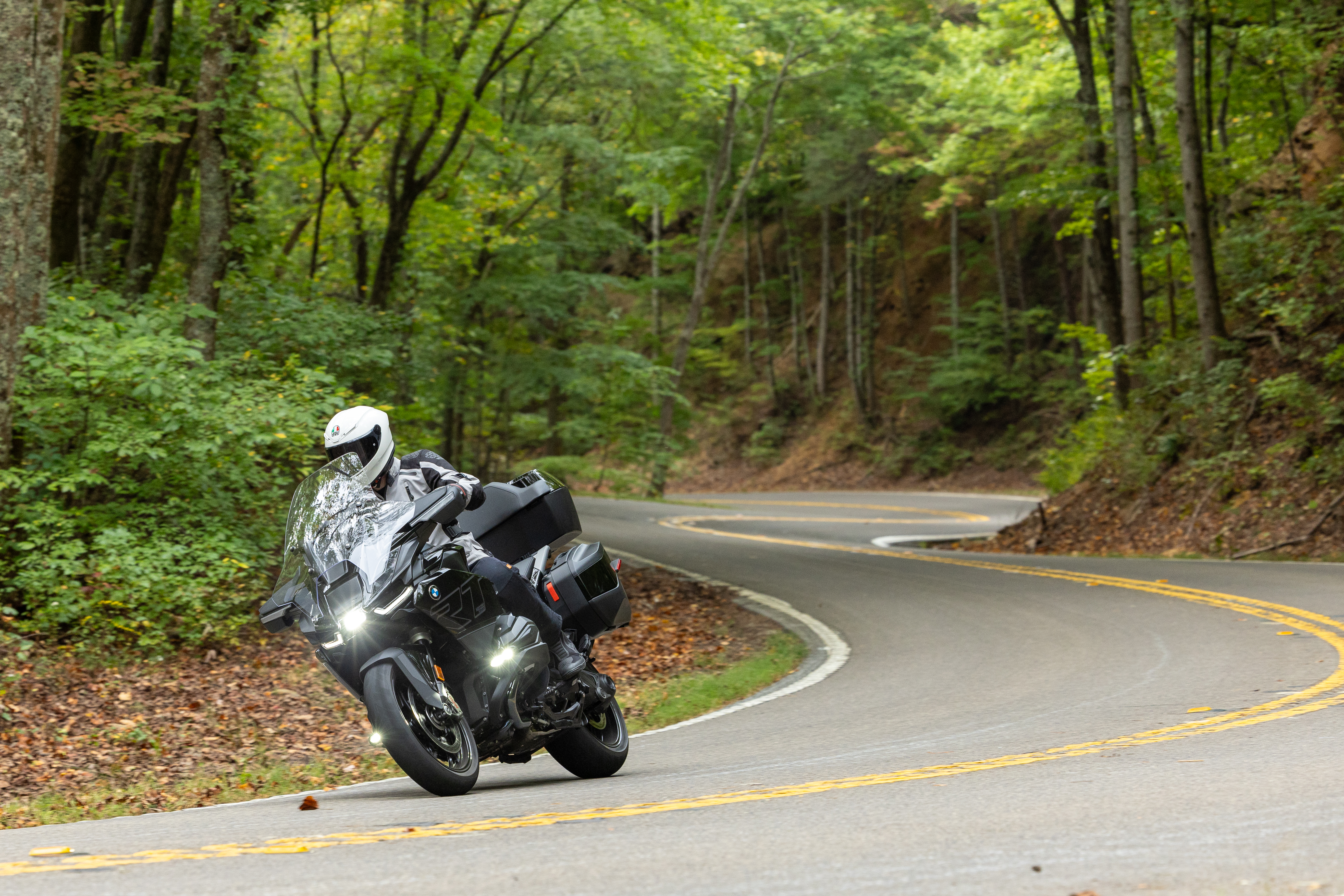
Every motorcycle has its place. When I had a 1,200-mile ride to get home, I was glad to be on the BMW R 1300 RT, with all its capability and comfort features. Photo by Kevin Wing.
In the world of motorcycling, there are a few motorcycles bigger and more luxurious than the R 1300 RT, though very few with more rider aids and comfort features built in. And there are motorcycles smaller and more rudimentary than the KLX300SM, though it’s near the end of the spectrum in the U.S. market. Riding them back to back once I got home was instructive.
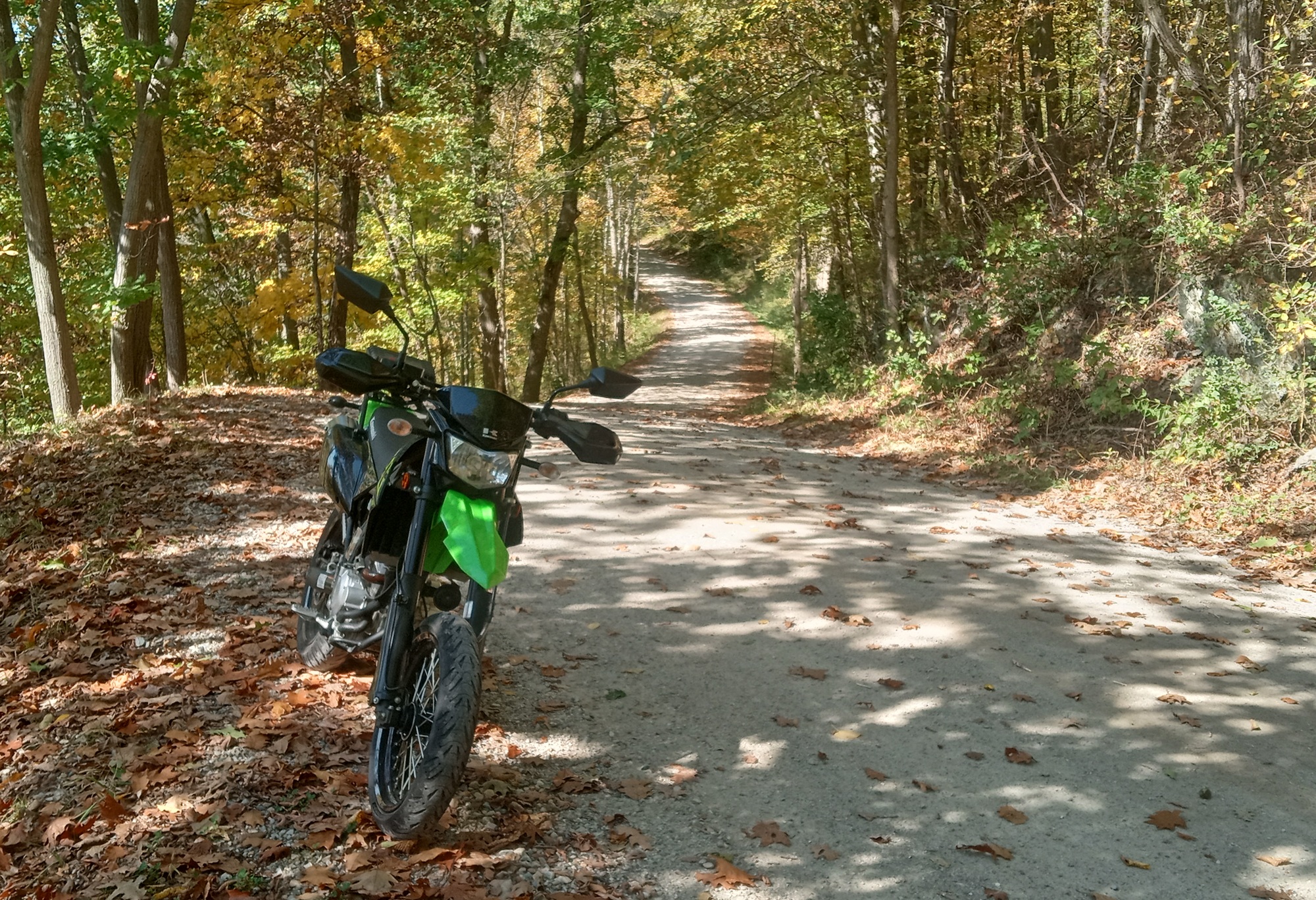
Every motorcycle has its place. For exploring local roads like this, I’d much rather be on the KLX300SM than a full-size heavyweight like the R 1300 RT. And for everyday transportation, such as a run to the hardware store or the library, small, simple, economical transportation just feels so much easier and more sensible.
After days of the R 1300 RT’s smooth thrust and push-button convenience, getting back on the KLX300SM was, to use a kind word, an elemental experience. Oh right, I have to pull the clutch lever every time I shift gears. Why does it take so much effort to twist the throttle on this little motorcycle? Why does everything feel so… rough?
On the other hand, riding the R 1300 RT simply demands more mental bandwidth, despite its many electronic rider aids. Simply moving it around the garage is a workout, and I’m always thinking. I can’t park anywhere that would require me to back up the BMW, without the aid of gravity. If the pavement is sloped at the stop sign, I make sure to put down my uphill foot, because I don’t want to go past the 650-pound machine’s tipping point and test my leg strength.
The KLX300SM is just so easy to ride, by comparison. On the R 1300 RT, I’m deliberate with parking lot maneuvers, like bringing an ocean-going ship into a berth. On the KLX300SM I whip it around like a bicycle packing mechanical muscle.
If all I ever rode was the KLX300SM, it would be so easy for me to get sloppy with my riding habits. If I make a small mistake, I can probably muscle my way out of it. If using the wrong technique gets you pointed toward trouble on the R 1300 RT, recovery is far more difficult. The hand of God may not be enough to save you.
I’ve met beginning riders who have ridden only one or maybe two motorcycles and so that’s their definition of “normal,” even if it’s not a middle-of-the-spectrum ride. Even some experienced riders, such as one YouTuber with a big following who I won’t name, suffer this. If you’ve only ridden cruisers, you might get on a standard motorcycle with very neutral ergonomics and declare it to be very sporty in its stance. It’s not. It’s just your skewed frame of reference.
Professional racers ride different kinds of motorcycles on different surfaces to enhance their skills. For us ordinary street riders, riding different kinds of motorcycles still has benefits. My instructor friend and neighbor Ken Condon, who’s the same age as me and a highly skilled rider, amateur racer, and experienced instructor, makes a point of riding all kinds of disciplines: street rides on his vintage bike, track days on his high-performance naked bike, off-road on both his middleweight adventure bike and his lighter dual-sport, and in the winter he rides on the ice on the frozen lake by his home. The main reason he can ride anything, despite being retirement age, like me, is because he does ride just about everything.
Riding different kinds of motorcycles helps keep us from falling into bad habits. If you’re a rider who has only ever ridden one kind of motorcycle because you think that’s what you like, how do you really know if you haven’t experienced something different? I know of pro racers who make their living riding on the edge aboard 250-horsepower missiles who admit sometimes they just want to get where they’re going on a scooter. I’ve had fun and learned a few things while trying to reach 170 mph on the long straight at Losail International Circuit in Qatar (the subject of the chapter “Dream Riding in Boomtown” in my book) and getting around town on an unsophisticated tiddler making single-digit horsepower.
It’s a big motorcycling world out there. I always recommend visiting some of the foreign provinces now and then. It’s a mind-expanding experience.




I never understood the tribal nature of motorcyclists. I own and have owned everything from American V-twin tourers, to dual sports, ADVs and the odd naked sport bike. I even own a cruiser. I never felt compelled to choose one genre of motorcycle. I think many motorcyclists ride to belong to a a group first and foremost. I ride to make myself smile. I am an eclectic guy with eclectic tastes, I guess,