I don’t remember when I first heard about the Motorcyclepedia museum opening in Newburgh, N.Y., but I do remember my reaction.
Logically, I should have been highly interested and excited to go see it. Here was something to do with motorcycling — my (increasingly almost only) interest, my job, my transportation — coming full circle with a place that played a formative role in my life. You see, I have history with Newburgh. But it was that history that shaped my reaction, which instead of curiosity and excitement was skepticism.
When I graduated from college with a journalism degree more than 40 years ago, my first job was as a reporter for The Evening News, the long-since-defunct and not-very-lamented daily newspaper in Newburgh. Pay was low and prestige perhaps even lower, but considering that journalism schools of the era were turning out graduates at many times the demand and that I was entering the job market during the final stages of the worst recession in the United States since the Great Depression, it felt like a win just to get any job at a daily newspaper.
I got a good education in college, but a better one the next three years on the job in Newburgh. The federal government used a variety of statistics in those days to measure urban distress, to determine eligibility for federal grants, and Newburgh ranked in the top five cities nationally. Crime, political battles, and a steady flow of shysters and dreamers passing through City Hall, drawn by the prospect of federal dollars, all kept a young reporter busy and learning the ropes. There was never a day without news.
But those shysters and dreamers and political hacks also led me to expect disappointment, which was a common sentiment in that beleaguered small city perched on the banks of a beautiful section of the Hudson River. When I learned that a motorcycle museum had been opened in Newburgh in 2011, my old skepticism kicked in. Even though I passed through the region periodically, and even though I’ve lived just over 100 miles away for the past two and half years, I never went to see it. I didn’t want to be disappointed.
A few days ago, I finally went. Turns out I shouldn’t have been worried. Motorcyclepedia is a fine museum, well worth an afternoon’s visit. What I didn’t count on was the surprisingly deep motorcycle culture in the area, known as the Mid-Hudson region of New York. And, after thinking about it a while, there was a reason for that, too.
But first, a trip.
A ride to Newburgh and other past landmarks
Having recently sold my Honda VFR800, the motorcycle I have automatically chosen for any out-of-town trip for the past five years, I pressed my 28-year-old Speed Triple into duty for the day. After meeting an old friend (another news reporter from those long-ago times) for coffee in Beacon, N.Y., I rode the Speed Triple on one of the most dramatic short stretches of road in the area. NY Route 218 loops off U.S. Route 9W at the village of Cornwall-on-Hudson and skirts past the U.S. Military Academy at West Point before reconnecting with 9W. Along its short route, it climbs a rock-faced cliff picturesquely called Storm King Mountain. The road is a mere notch carved into stone, hundreds of feet above the Hudson. There’s only one tiny place to pull over, which makes it hard to get a decent photo that shows the sheer, precipitous nature of the place. A storm in 2023 washed away part of the road and it was closed until last fall, so this was my first time back to ride it since it reopened.
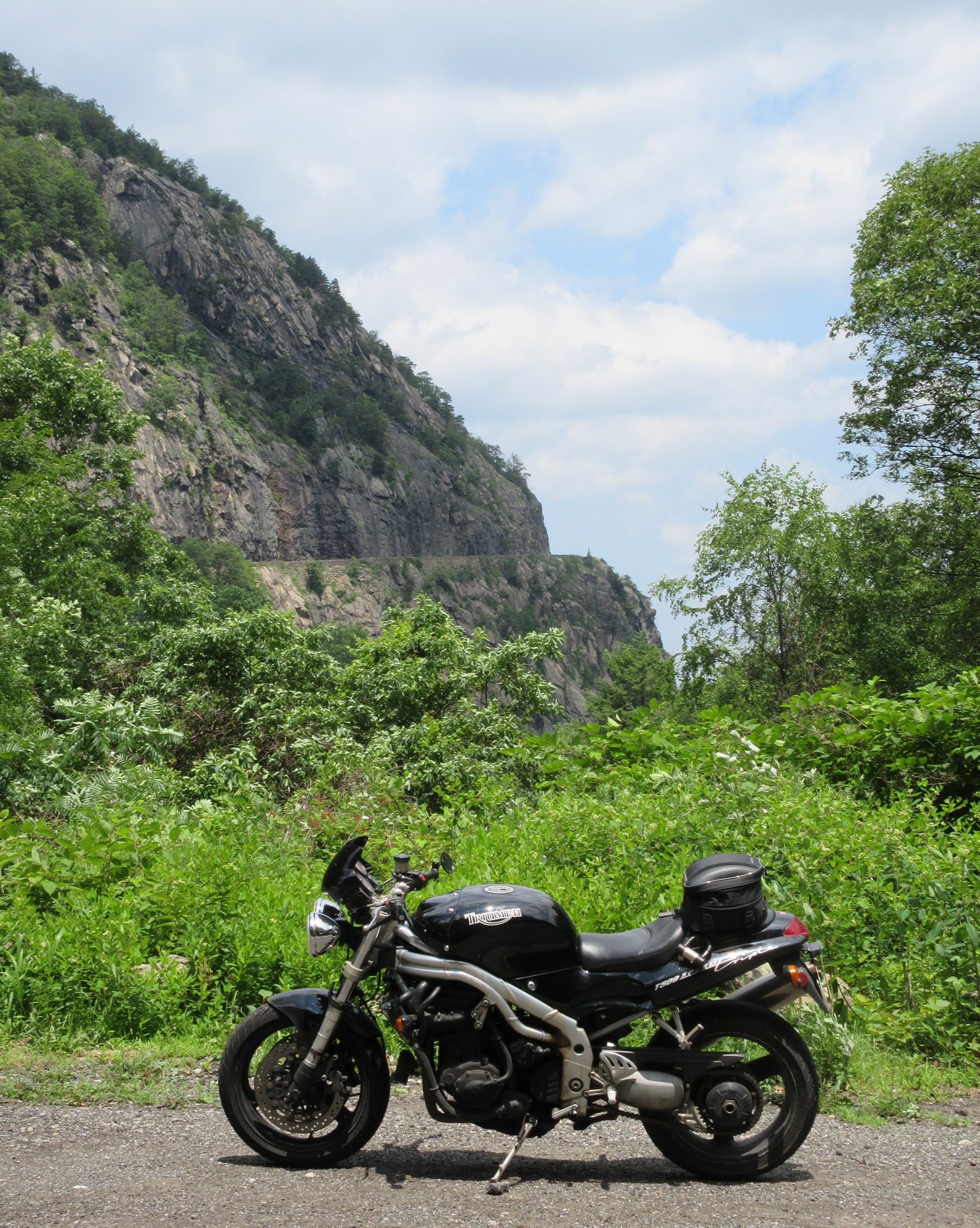
That notch on the stone wall of Storm King Mountain is the road. Narrow, twisty, and with just a low stone wall as a safety net. Hit that stone wall and go over the edge and they might recover your body someday. Maybe.
After my return visit to Storm King Mountain, a place I’ve been enjoying now for more than four decades, I looped back into the city to Motorcyclepedia.
A visit to Motorcyclepedia
In 1947, Gerald “Jerry” Doering bought his first motorcycle, a 1929 Indian Scout. From there, you might say, things accelerated. He passed his love of motorcycles on to his son, Ted, who built choppers as an adult and then started a company selling parts and accessories mostly for V-twins. Father and son kept adding to their collection. In 2011, they created a foundation and opened the museum, with motorcycles of their own and others on loan from Antique Motorcycle Club of America members.
The focus of Motorcyclepedia is early American. In the early 20th century, dozens of entrepreneurs starting bolting motors into bicycles in backyard sheds, and while a few became giants, like Harley-Davidson, Indian, and Excelsior-Henderson, most faded away. You’re sure to see some early-1900s brand you’ve never seen before. (I’m pretty sure I saw my first Emblem.)
But some of the displays are clearly derived from the personal interests of the founding father and son team. Not surprising, given Jerry Doering’s start with a Scout, Indian is the biggest exhibit. There’s an example model of every year from 1901, when Indian first bolted an engine sourced from another manufacturer into a bicycle, through 1953, when the original company, once the largest in the world, went out of business. Those first few years are covered by replicas. Some years are covered by restored beauties, and others with unrestored, patina-rich, original examples.

One unique feature of the Motorcyclepedia museum is the Indian timeline, with one model on display for each year from the company’s founding in 1901 to the closure of the original Indian in 1953.
Motorcyclepedia also devotes a good portion of its 85,000 square feet to a display of choppers, which matches Ted Doering’s history of building them. There’s also an exhibit on motorcycles in TV and movies, plenty of early American rarities, and some interesting oddities such as a Ducati 999S sliced down the middle, so it’s not just the cutaway engine you’ve probably seen before, but a cutaway motorcycle, with each component carved in half to display internals. If you want to get a better idea of what’s to be seen inside Motorcyclepedia, go over to my article at Common Tread and see the photo gallery.
Personal connections
Seeing the displays, I questioned myself. Why had I been so skeptical that Motorcyclepedia would be worth a visit? Part of it was my bias from long ago, and of course, times have changed. Not entirely. But changed. Most people today would drive down Broadway in Newburgh, the wide avenue leading to the Hudson, and consider the city to be a pretty downtrodden place. But I’m here to tell you it’s miles better than it was back in my day. They may be small, low-rent businesses in those storefronts, but they were empty sockets back when I lived there.
But more importantly, I think I’d forgotten, or overlooked entirely, the rich motorcycle culture of the Mid-Hudson region, as this area is often called, and how that is a foundation for something like Motorcyclepedia. This was Jerry and Ted Doering’s hometown, and the son built a motorcycle business here. Not far from the museum is Moroney’s Harley-Davidson, a dealership that played an enduring role in sponsoring race teams, mostly in flat-track but also in roadracing, for decades. Current professional racers P.J. Jacobsen, in roadracing, and Justin Barcia, in motocross, came from this region. As a display in Motorcyclepedia educated me, custom builder Indian Larry was a native of this area, born in nearby Cornwall-on-Hudson along Route 218 and made his first welding attempts in a local shop.
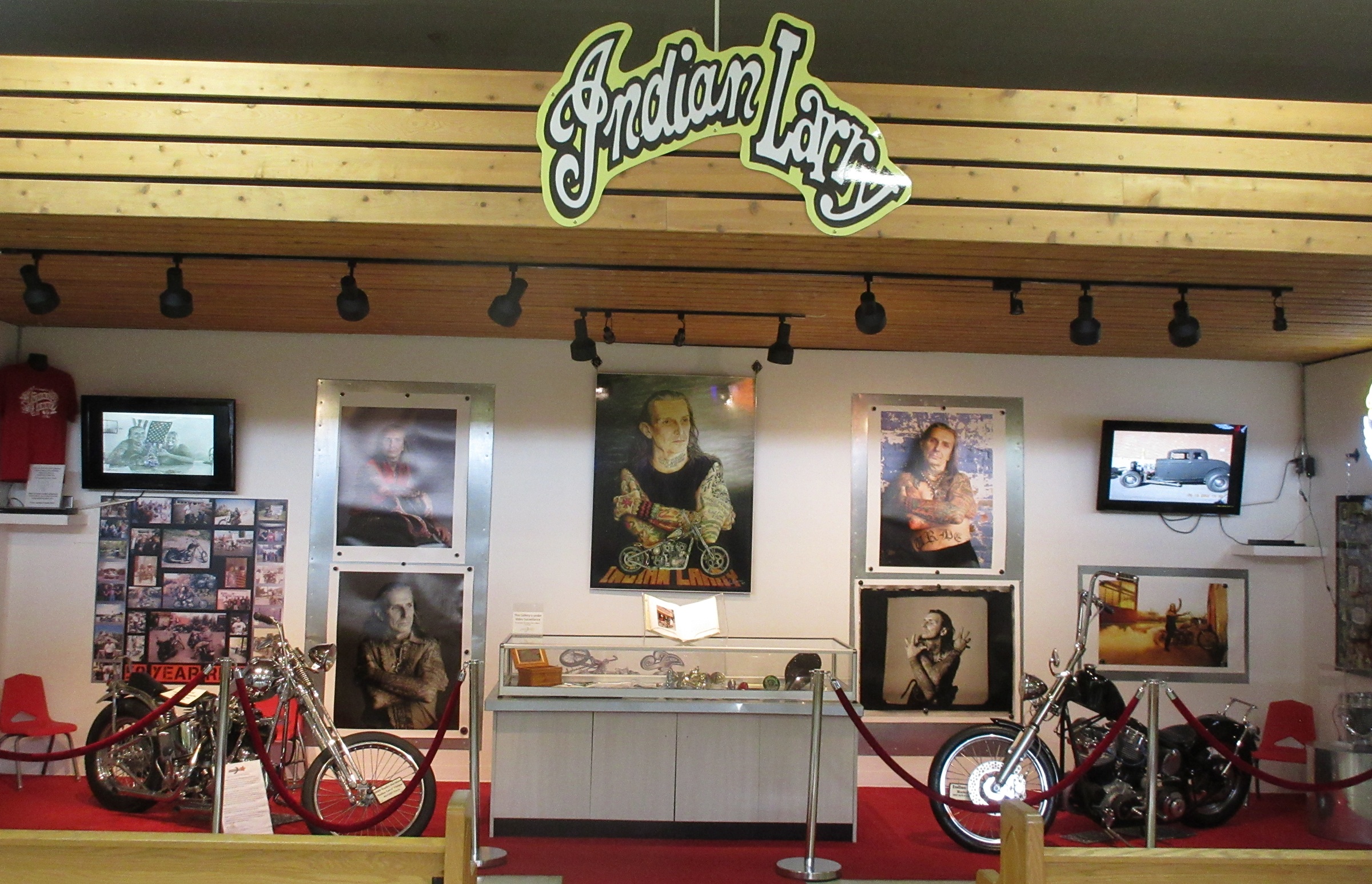
While he made his name mostly in New York City, Indian Larry was also a native of the Newburgh area. As I kept peeling off the layers, I found more and more motorcycle culture from the region.
A display of Ted Doering’s first motorcycle, a Triumph Cub, noted that it was purchased from Al Weinert’s shop in nearby Middletown. That drew some vivid memories of my own to the surface.
After three years working in Newburgh, I moved to the bigger, better quality daily newspaper in Middletown, just 25 miles west. One of the most memorable stories I ever wrote there came just before one July 4. An anonymous caller said that then-Bruce Jenner (today Caitlyn Jenner) was having an impromptu demolition derby at a junkyard on the edge of town. The assignment editor was skeptical, but sent me to check it out anyway.
At the time, Jenner was still an American celebrity athlete, having won the gold medal in the decathlon at the 1976 Summer Olympics. Post-Olympics Jenner was a race car driver and television racing commentator and on that day was traveling upstate from New York City and stopped in to see old pal “Jammin'” Jimmy Weinert, a three-time motocross and Supercross champion who grew up in Middletown and whose family still owned the salvage yard. (His father, Al, previously had a motorcycle shop and sold the Triumph to Jerry Doering for his son, Ted.)
I ended up writing the most unexpected of stories after watching an Olympic hero and a former motocross racer bash into each other for fun in worthless cars in a junkyard. (If you’re interested, you can read the original story in PDF form here: page one, page two.)
With all this motorcycling culture around, from racers to business owners to chopper builders, how did I not notice? Thinking about it a little, the answer came pretty quickly.
You see, when I left college, skipping my own graduation so I could get on with life and start my new job even sooner, I only owned one thing of even modest value. My motorcycle. And right there in the job description was the requirement that I had to have my own car, so I’d have transportation to get to assignments. While I’d gotten by during one winter-break internship at the small local newspaper in West Virginia by using my motorcycle for transportation (with unfortunate results once), that clearly wouldn’t work for a so-called professional in Hudson Valley winters. So I sold my motorcycle to raise funds to buy a crappy used car.
Thus began a rare motorcycle-less period in my adult life. I coped by pretending I didn’t care. I tried to refocus my interest on cars (even though I couldn’t afford a nice one of those, either). I steadfastly ignored the motorcycle world for a few years.
In my defense, at that time Weinert was retired from racing and Jacobsen and Barcia were not born yet. Moroney’s was just ramping up its racing efforts, not yet the influential team it would become. I don’t remember if I ever heard of the Doerings. And yet it probably wouldn’t have mattered if I did.
Here we were 40 years later and I underestimated Motorcyclepedia in part because I’d failed to learn about the local motorcycle culture I lived in back then. And that was mainly a coping mechanism on my part.
It was something to think about on the meandering ride home through the Hudson Valley and into the Berkshires of western Massachusetts. Live long enough and you may find yourself considering new perspectives on now-ancient history. The old Speed Triple I was riding, for example, is one of the possessions I’ve owned longest. Yet it came along several major life changes after my days in Newburgh.
Just for fun, and to end on a quirky note, I stopped on the ride home to get the photo below.
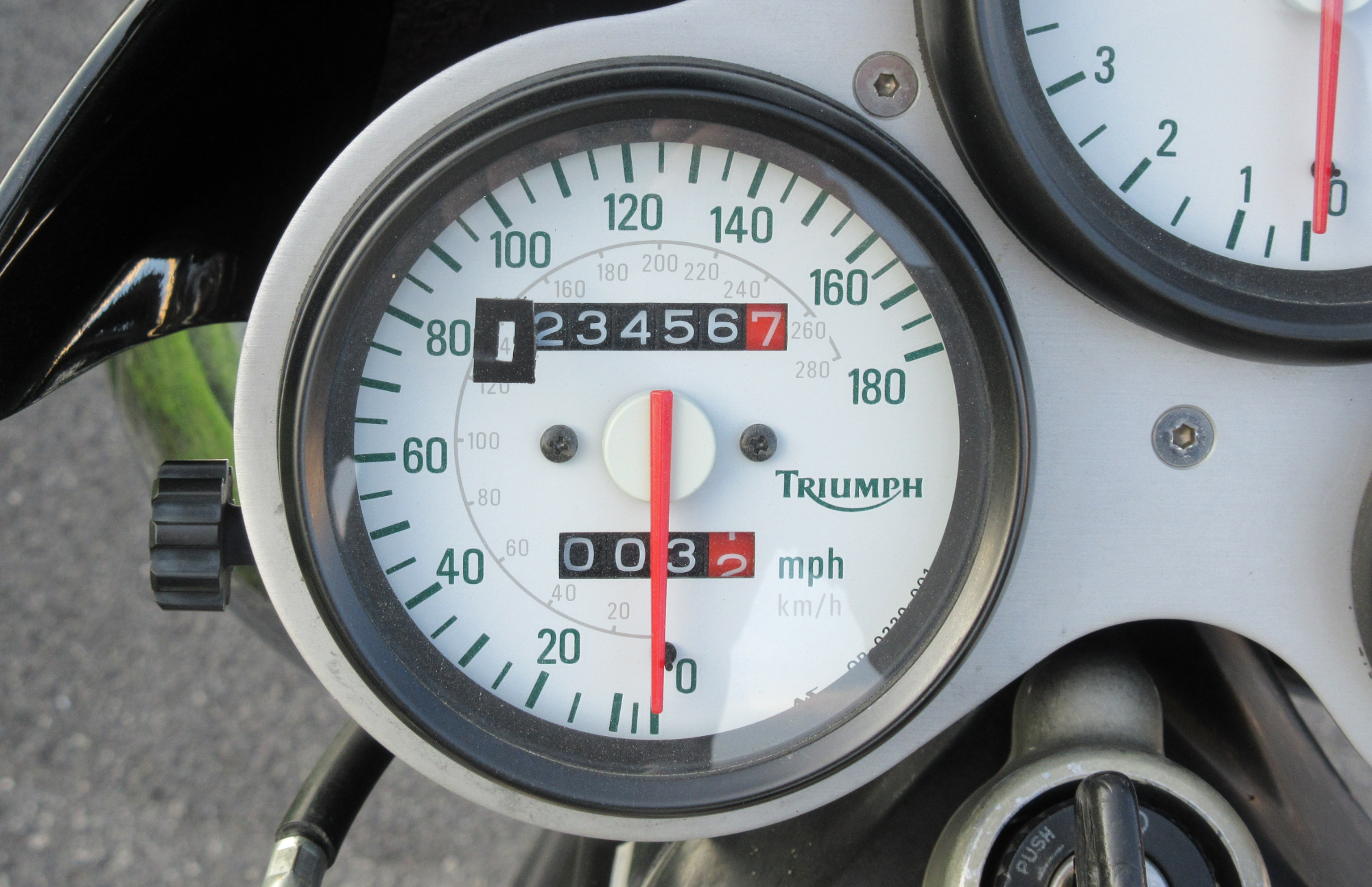
On the way home, my 28-year-old Speed Triple, which I’ve owned for 27 years, hit another interesting milestone. Anyone want to play odometer poker?
All told, it was a surprisingly enlightening day. A little over 300 miles on the Speed Triple, the longest outing it has seen since I rode it to Massachusetts from West Virginia. A visit to the resurrected Route 218, one of my favorite dramatic natural spots. A fresh perspective on old (very old) haunts. And a pleasant surprise in the form of a motorcycle destination worth a visit.
Check out Motorcyclepedia if you’re in the area and have the time.